


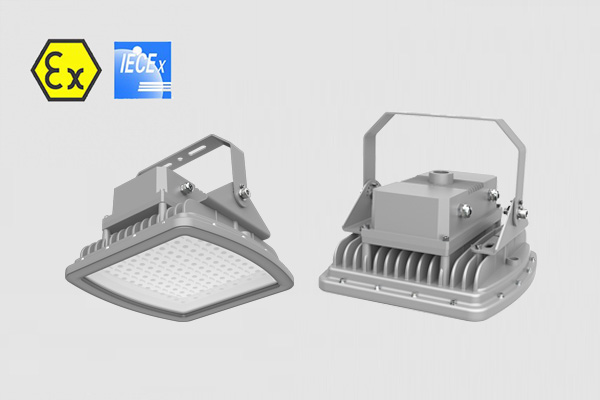
IECEx ATEX Certified Explosion proof LED Lights - Zone 1 Zone 2 Hazardous Area Lighting
CESP Zone 1 Zone 2 hazardous location LED lights are in accordance with International Protection Techniques (Equipment Protection Levels), including IEC/EN 60079-0 (General Requirement), IEC/EN 60079-1 (Flameproof Enclosure), IEC/EN 60079-7 (Increased Safety), IEC/EN 60079-11 (Intrinsic Safety), IEC/EN 60079-15 (Type of Protection), IEC/EN 60079-18, IEC/EN 60079-28, IEC/EN 60079-31. If you are not sure about the Classified of your lighting application environment, please contact our technical department for the solution.
For Zone 1 Zone 2, Zone 21 Zone 22 hazardous area led lighting, 20W - 200W, 130lm/W,aluminum alloy + 8mm tempered glass, multi-installation for different projects, such as light tower, canopy light, marine grade.
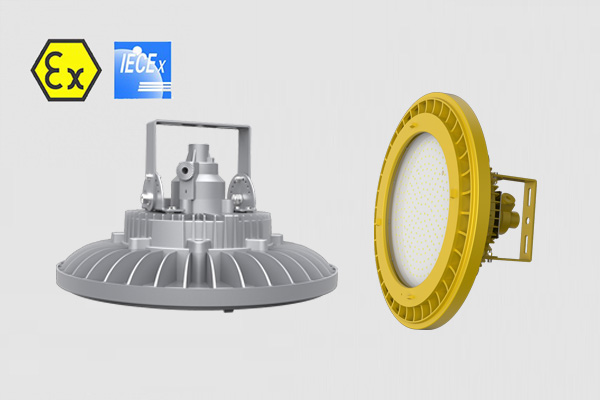
Flameproof enclosure, Ex db op is IIC T6 Gb, Zone 1 & Zone 21 with explosive gas atmosphere, Zone 21 and Zone22 with explosive dust atmosphere, 10mm temered glass, 7J impact resistance,up to 26000lm.
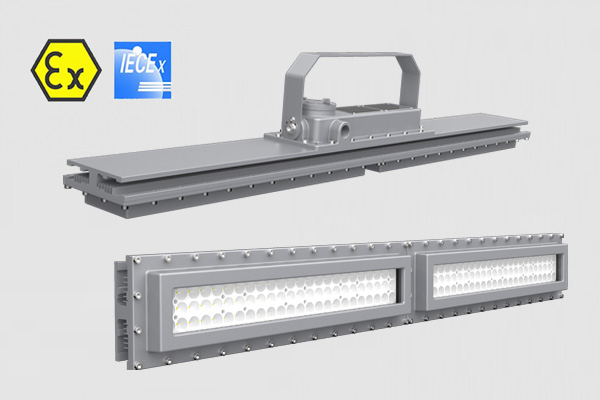
Flameproof enclosure, Ex db op is IIC T6 Gb, IP68 protection grade, tempered glass 10mm, withstand impacts up to 10J, 2 foot and 4 foot Length, 50Watt- 240Watt, 130lm/W light efficacy.
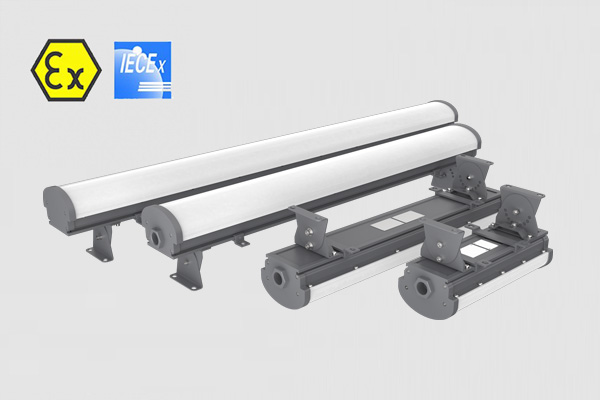
Zone 1 & Zone 21, 1ft, 2ft, 3ft, 4ft length can be selected, replace the traditional explosion-proof three-proof lamp, explosion-proof fluorescent tube, anti-corrosion, anti-glare, anti-drop, competitive price.
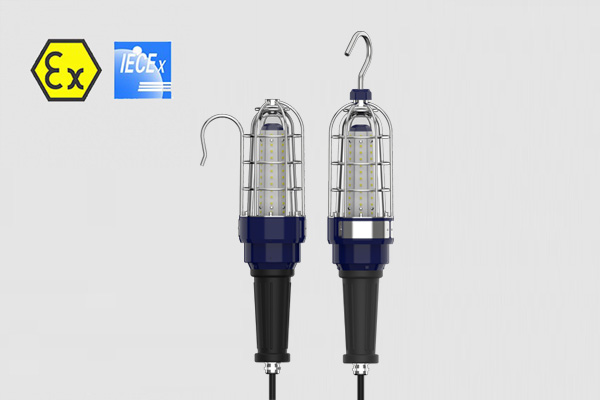
Flameproof LED hand lamp for Zone 1 & Zone 21 hazardous areas, 10mm tempered glass, pass the multi-angle drop test, 10W, 20W, 30W Power, can be connected to the cable, emergency power box.
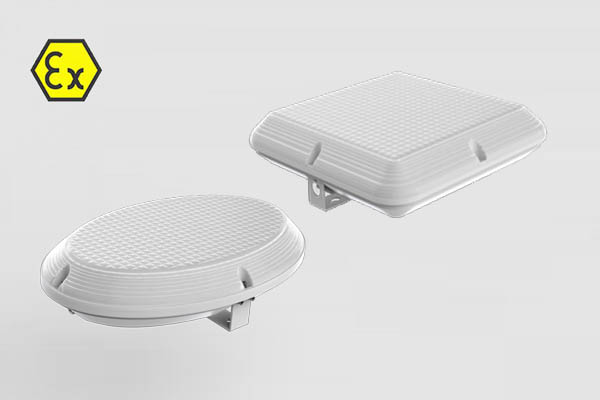
The CES-EX-SF series explosion-proof ceiling lamp has a strong shell, with features such as impact resistance, vibration resistance, and corrosion resistance. It can be used in hazardous environments of Zone 1&21, Zone 2&22.
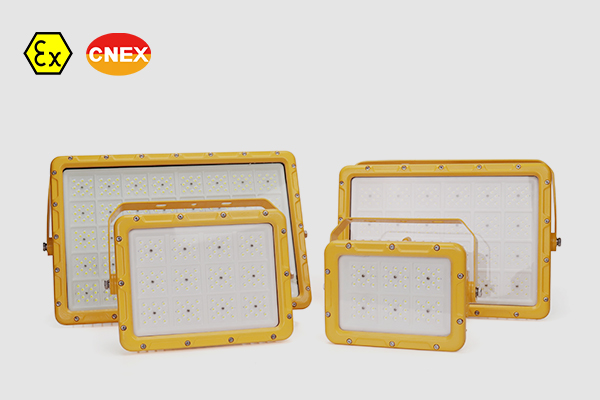
CES-EX-JX Series is your go-to solution for illuminating hazardous Zone 1 and Zone 21 areas. With ATEX approval, these Explosion-proof LED Flood Lights offer unbeatable safety standards.
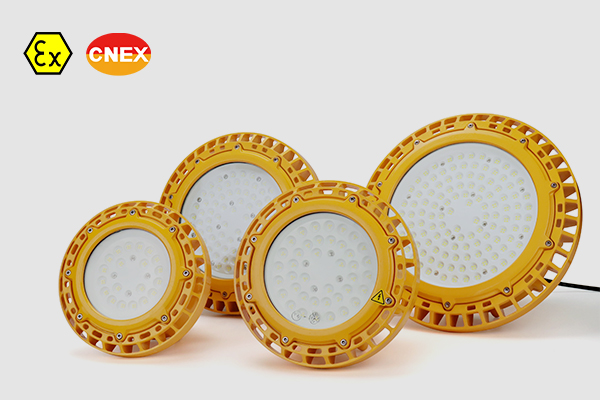
Discover the pinnacle of safety and illumination with our CES-EX-GBX Series Explosion-proof LED High Bay Lights. Designed for hazardous Zone 1 and Zone 21 areas, these lights boast ATEX approval, ensuring the highest safety standards.
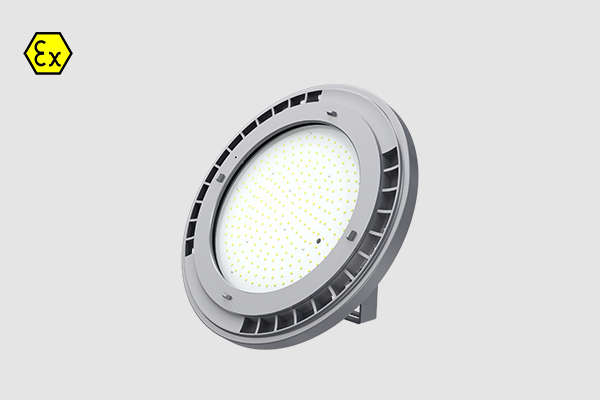
GB-02 explosion-proof lights are made of alloy aluminum and tempered glass, with shock resistance and anti-vibration performance. The luminaires have passed the ATEX IECEx standards test, from 30W to 80W for hazardous area lighting.
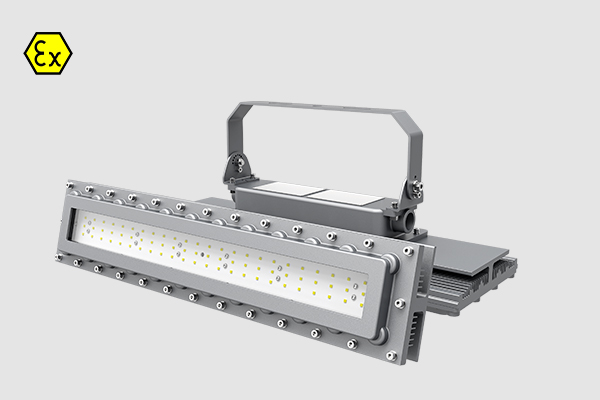
LN-02 explosion-proof lights obtained an IECEx ATEX certificate, it's safe for the Zone 1 and Zone 2 hazardous locations. The copper-free aluminum alloy body is powder-coated to increase durability and beautiful appearance, are able to withstand violent shaking and shock resistance.
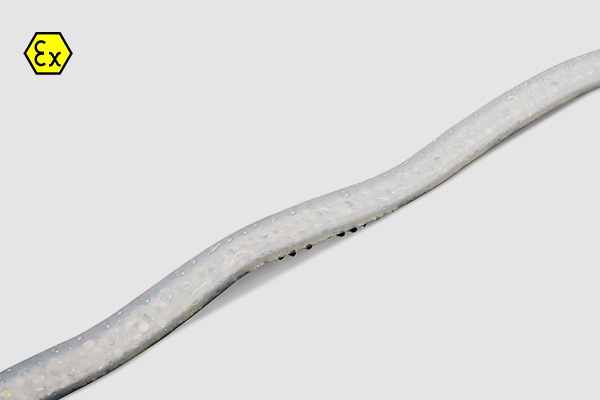
an innovative line of LED hazardous area lighting products, specifically designed for use in potentially explosive atmospheres (Zone 1/21 & 2/22) within harsh industrial settings such as coal mines and oil & gas facilities.
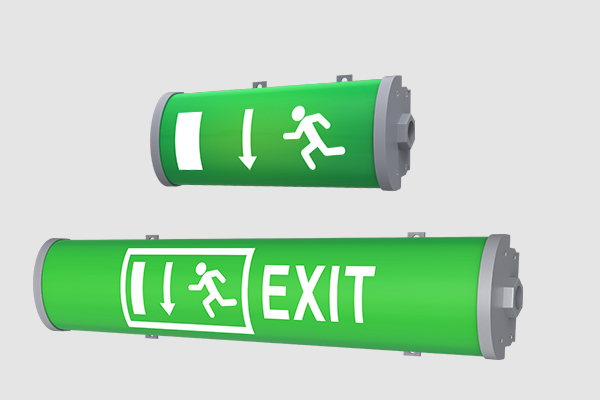
Explosion-proof safety exit lamps are for personnel evacuation, and fire operations to provide lighting fire emergency lamps! It usually uses an external power supply, when the power automatically switches to the battery power state!

Wednesday, 09 June 2021 01:33
Why does sulfur dust explode and how to prevent it ?
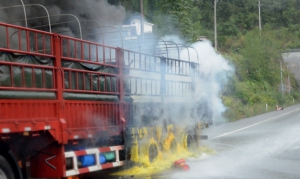
Ordinary natural gas purification plant has an annual sulfur production capacity of 240 x 10' t. The sulfur molding process adopts wet molding. The product is granular sulfur with a diameter of 3 ~ 5mm, which is stored in two sulfur silos with a storage capacity of 5.7×10°t. Transport to the car or train loading building by conveyor belt. Sulfur particles produce a large amount of sulfur dust in the process of transportation, transportation, and loading. Dust monitoring and suppression systems are set up to control the dust hazards. However, sulfur dust also has the risk of explosion under certain conditions.
- The physical and chemical properties of sulfur
Sulfur is a secondary flammable solid, non-toxic, CAS number 7704 -34-9; powdered sulfur is light yellow powder, specific gravity 1.96, bulk sulfur is light yellow crystals, specific gravity 2.05, melting point 112.8 ~120 ℃, boiling point 444.6 ℃, The flash point is 207.20 ℃. Easily soluble in carbon disulfide, insoluble in water, slightly soluble in ethanol and ethers. The burning temperature of sulfur is generally 248 ~ 261 ℃, and the burning temperature of powdered sulfur is only about 190 ℃, and it burns with a blue flame; when it is stained with iron sulfide, iron oxide (rust), engine oil, metal powder, carbon powder and oxidant substances , It is easy to ignite sulfur and cause fire; sulfur dust in the air or mixed with oxidant is easy to burn, and even cause dust explosion.
- Hazard Analysis of Sulfur Dust Explosion
- Sulfur combustion characteristics
Due to the different molding methods, sulfur is in the form of powder, granules, flakes, or lumps. It exhibits different combustion performance under different conditions and states. When the solid particle size is small, it exhibits flammable characteristics. The product of sulfur combustion is mainly sulfur dioxide, and its combustion heat is 300kJ/mol. Sulfur can cause fires under heat, impact, friction, etc. It will generate static electricity in the process of crushing, grinding, storage and transportation, causing spontaneous combustion and explosion.
- Sulfur dust explosion conditions
The explosion characteristics of sulfur dust are affected by a variety of factors, and there should be "5 conditions" to cause a sulfur dust explosion: combustible dust, dust cloud, ignition source, combustible material, and limited space.
- Hazard Analysis of Dust Explosion in Sulfur Storage and Transportation System
Combining the process characteristics and safety characteristics of the sulfur storage and transportation system of the purification plant, the hazard of sulfur dust explosion during the storage and transportation of the purification plant is analyzed.
- Friction, impact sparks. During the transportation process of the sulfur particles, the sulfur particles and its storage and transportation equipment hit the sparks. When the sulfur particles violently collide or rub against each other, the sparks generated by the impact or friction fall off high-temperature solid particles. Tests have shown that if the diameter of the sparks is 0.1 ~ 1 mm, its energy can reach 1.76 ~ 1 760 mJ, which may ignite sulfur dust. The static electricity generated by the friction between the particles, dust and the conveyor belt and the particles and dust, under appropriate conditions, can have an electrostatic voltage of several to tens of thousands of volts, and the energy generated is far greater than the minimum ignition energy of sulfur particles.
- Spontaneous combustion of ferrous sulfide on the surface of the equipment. The carbon steel equipment is made of materials that are prone to produce ferrous sulfide, and it will produce ferrous sulfide on the surface in long-term contact with sulfur; an appropriate amount of water has a positive catalytic effect on the spontaneous combustion process of ferrous sulfide, and the initial self-heating temperature of FeS can be reduced from 140.93°C when there is no water. To 40 ~ 60 ℃ when water is contained; when the humidity in the air increases, the self-heating performance of ferrous sulfide will gradually increase; self-heating and spontaneous combustion of ferrous sulfide occur. When the heat is released to a certain degree, it can form an open flame to ignite the surrounding flammable Substance: As the air flow increases, the heating rate of ferrous sulfide gradually increases.
- Electric sparks caused by electrical equipment failure.
- The equipment generates heat due to friction due to lack of lubrication at the mechanical running parts.
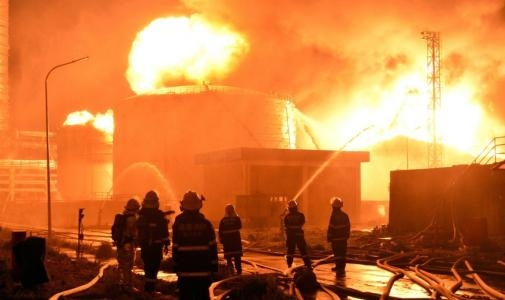
- Analysis of Dust Explosion Hazard in Storage and Transportation
- Storage system
- Bulk sulfur blanking point. The sulfur material falling from the top to the bottom by its own gravity at the blanking point is likely to cause dust to fly, so that the sulfur dust and the air are fully mixed to form a dust cloud, which is easy to cause combustion and explosion.
- A large number of sulfur particles are piled up. It may come into contact with oxygen in the air to produce an oxidative exothermic reaction. If the heat is not sufficiently dissipated, the temperature will increase and cause spontaneous combustion.
- Sulfur dust deposited in pits, depressions, ditches, dead ends and equipment surfaces. If these dusts are not removed in time, it is easy to cause dust to fly and form suspension explosion conditions during the cleaning process.
- There may be combustible gases such as hydrogen sulfide in the sulfur silos. These gases are heavier than air. There is also a fire and explosion hazard due to the accumulation of combustible gases at the bottom of the silo and underground corridors.
- Conveyor system
- Conveyor belt. Due to the sulfur produced by the wet molding process, there are some small fine powder particles of sulfur, and some of the sulfur particles adhere to the surface of the transfer belt during the transportation process, and fall due to the vibration of the belt and the change in tension, causing the fine powder sulfur to be scattered along the belt. build up. When the sulfur dust reaches a certain thickness, it can easily cause smoldering.
- Color steel ceiling. Sulfur powder falls from the return belt and accumulates more on the roof. When the surface temperature is high, the moisture continuously evaporates, acidic sulfur powder and corroded iron sheet are easy to generate ferrous sulfide and spontaneously combust in the high temperature and humid environment, and will reduce the sulfur in the interlayer. The powder ignites.
- Power cable. When the spontaneous combustion of ferrous sulfide causes the sulfur in the cracks of the roof to liquefy around the flame, the sulfur with the flame flows into the cable rack under the shed, which will cause the cable rubber to burn and cause more serious combustion and explosion accidents.
- Friction static. The static electricity accumulated during the operation of the belt conveyor may cause the sulfur to burn and explode.
- Loading system
- The loading equipment corrodes and catches fire. For example, the buffer bin and screw feeder are corroded and perforated, the ram tie rod joints have been corroded and broken repeatedly, and the roof of the loading building has been corroded and caught fire.
- Buffer storage gate. Repeatedly automatically open and close for batching weighing cycle operation, it is easy to produce friction static electricity and cause sulfur burning.
- Bulk sulfur blanking point. Bulk sulfur quickly slides into the container from the height of the loading building. The friction and impact between the sulfur particles generate strong static electricity. After the formation of a dust cloud, static electricity and electric sparks can easily cause explosion accidents.
- Car loading yard. Sulfur dust is easy to form during loading, especially in the summer when the vehicles are packed tightly, and during the frequent parking and starting of the car, the sulfur dust is more serious and easy to cause spontaneous combustion.
- At the guide trough. During the transportation process, mechanical vibration and friction and collision between particles are prone to produce suspended sulfur dust, which is extremely easy to burn and explode.
- Sulfur dust deposited on heating surfaces such as lighting devices and hot surfaces of mechanical equipment may smolder after being heated for a period of time within a certain layer thickness range (such as 10 ~ 20mm).
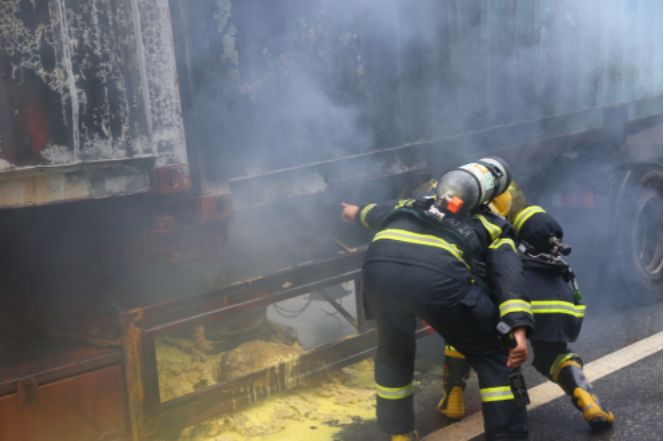
- Emergency measures to be taken in the event of fire and explosion hazards
Through the analysis and investigation of typical dust explosion accidents at home and abroad, it is found that if an explosion hazard can be discovered in time and effective measures taken in the early stage, the explosion can be avoided or casualties can be reduced.
- Due to the long induction period of sulfur dust explosion, sulfur dust catches fire and spreads slowly, and will release a large amount of smoke and pungent sulfur dioxide gas. The early characteristics are obvious, and it is easier to find out by post-enhanced monitoring.
- After determining that the sulfur is on fire in a restricted space, it is necessary to avoid direct impact of water flow on the periphery of the fire surface or the outer wall of the air duct; when conditions permit, it is best to use steam to extinguish the fire; if the on-site personnel cannot judge the correct disposal measures, emergency avoidance measures should be taken. Evacuate to a safe area in a dangerous way (stop all operations on site).
- When a sulfur pile is on fire, it is necessary to avoid directly impacting the sulfur pile or the ground around the fire point with a direct water jet. Because the air flow brought by the water column impacting the sulfur pile or the ground will disturb the sulfur dust and suspend the sulfur dust in the air, reaching the explosion limit, causing an explosion. , To expand the accident hazards. The best way to extinguish fire is to use nozzles with good atomization effect, such as atomizing water cannons or blooming water cannons, to pour the fire area to extinguish the fire. A water curtain spray system can be used together to form a liquid mist screen of fire extinguishing agent and reduce the impact of sulfur Surface causes the possibility of dust and sulfur suspended in the air.
- Do a good job in the safety of rescuers, because sulfur fires will release a large amount of toxic gas sulfur dioxide, which is easy to cause personnel poisoning. When extinguishing a sulfur fire, you must wear fire-proof and heat-insulating clothing and air respirators to avoid thermal radiation damage and avoid direct inhalation of toxic gases.
- When liquid sulfur is in danger of fire in the liquid sulfur storage tank and the liquid sulfur pool, the steam fire extinguishing system should be quickly turned on and the gas-phase connecting pipe control valve should be closed.
Practice has found that the best way to extinguish a sulfur fire is water and steam, and dry powder fire extinguishers are not effective.
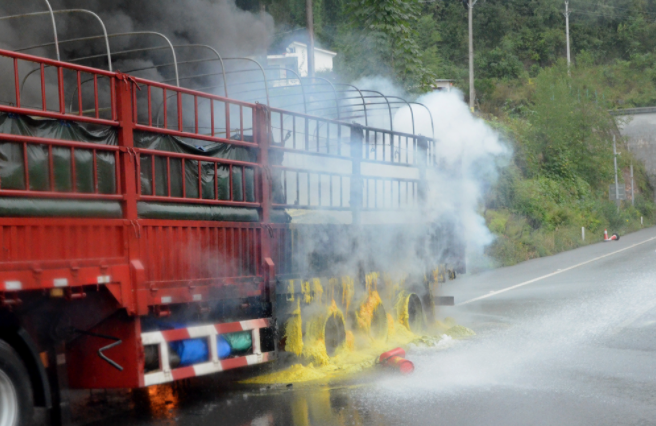
- Management measures to prevent sulfur fire and dust explosion
In the storage and transportation system, sulfur fire and sulfur powder explosion can be avoided. Preventive measures can be taken to avoid the burning and explosion of sulfur. Although control measures cannot completely prevent the occurrence of explosions, they can reduce losses as much as possible and control the consequences to an acceptable level.
- Strengthen daily management, find areas where ferrous sulfide and fine sulfur may accumulate, remove sulfur powder inside and outside the equipment, and reduce the risk of fire and explosion accidents caused by spontaneous combustion of ferrous sulfide and sulfur powder accumulation.
- Upgrade the materials of the key equipment of the storage and transportation system in contact with sulfur, and use materials that are not easy to chemically react with sulfur dust to avoid spontaneous combustion of ferrous sulfide.
- The early detection of sulfur burning is very important. While relying on the video monitoring system and the safety alarm system, the post personnel must strengthen the inspection of key parts of the site, and achieve early detection, early reporting, and early disposal of hidden dangers to control the accident in the budding state.
- Strengthen the maintenance and management of safety facilities, formulate a special management system, and regularly check the status of the silos and belt conveyors for spraying and dust suppression facilities. In the process of sulfur transportation, the system spray dust suppression facilities must be put into use; the silo dome spray facilities must be tried out once a week.
- Strengthen the operation and management of rotating equipment and regular lubrication to avoid the ignition of sulfur due to heat accumulation due to equipment friction.
- Strengthen the management of direct operations and improve the fire level of areas where fine sulfur is likely to accumulate. Feasible safety prevention and control measures must be formulated and implemented before a fire breaks out.
- Regularly carry out emergency drills for sulfur fire and dust explosion, and personnel should be trained in first aid and the use of gas defense equipment to improve the emergency response capabilities of employees.
Sulfur is a secondary flammable solid, and sulfur dust is easy to burn in the air or mixed with oxidant and even cause dust explosion. Therefore, both in the process of transportation and storage in the warehouse should be stored reasonably, and the equipment for storing sulfur should also be selected for products with a working temperature of less than 190°.
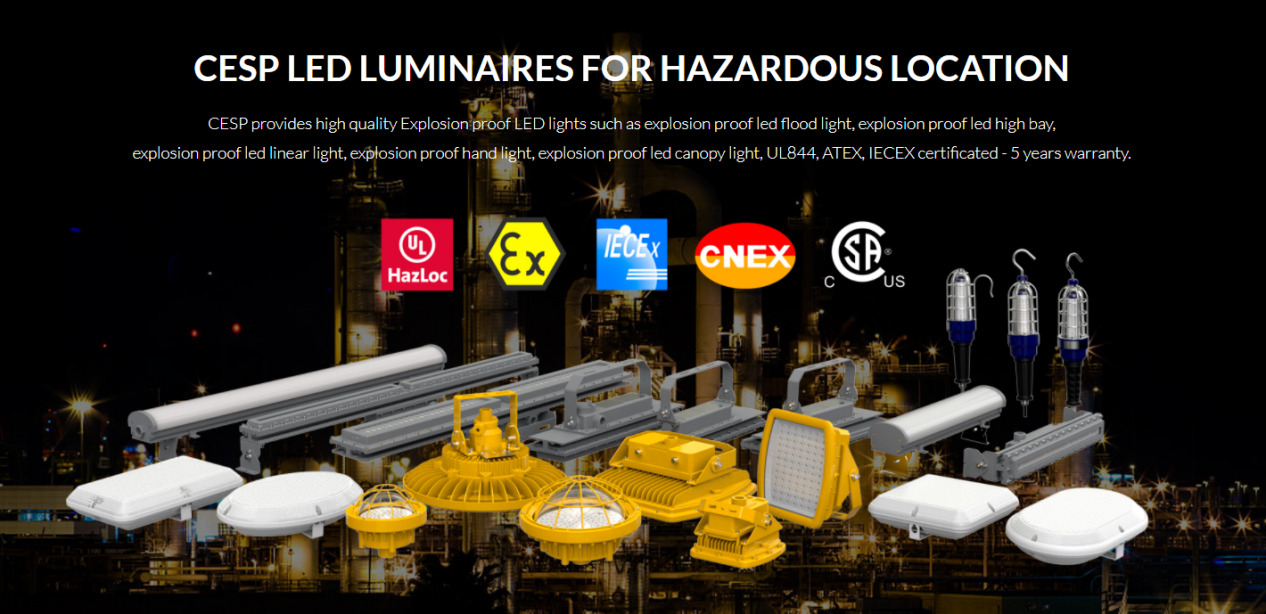
Shenzhen CESP Co., Ltd. focuses on the field of special industrial lighting. It is a high-tech enterprise integrating design, R&D, production and sales. A complete management team provides expertise in the lighting fields of domestic electric power, metallurgy, railways, large industrial and mining enterprises, and marine ships. It also provides advanced technical support and product supporting services for internationally renowned companies.
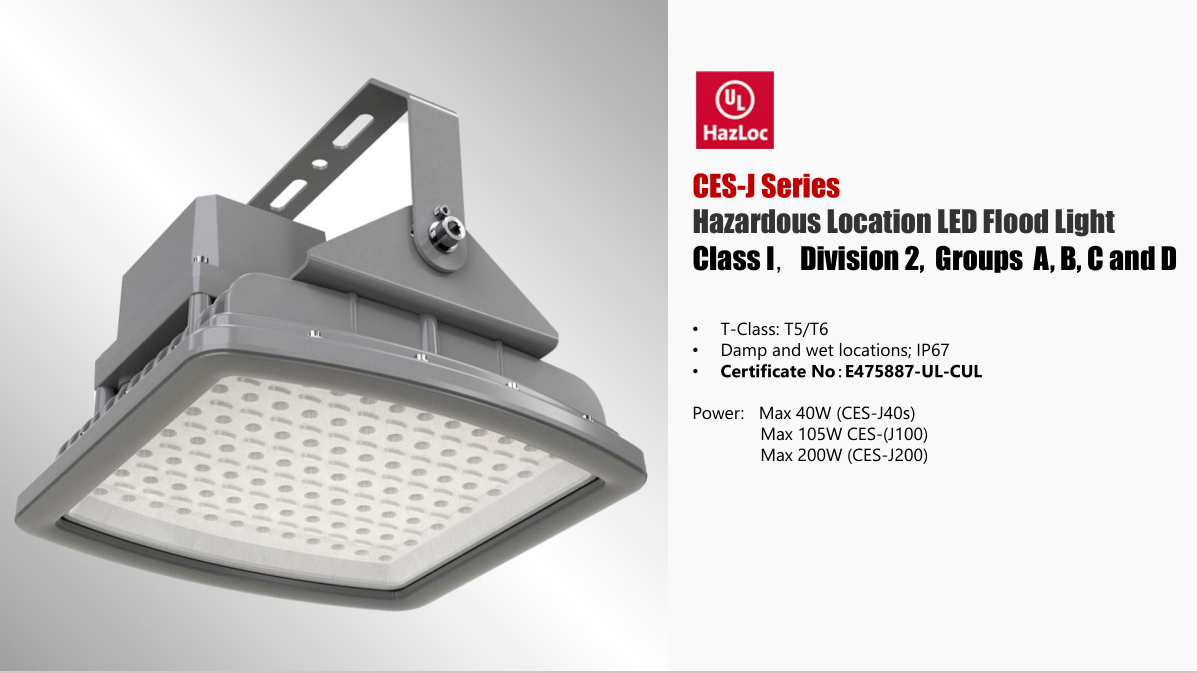
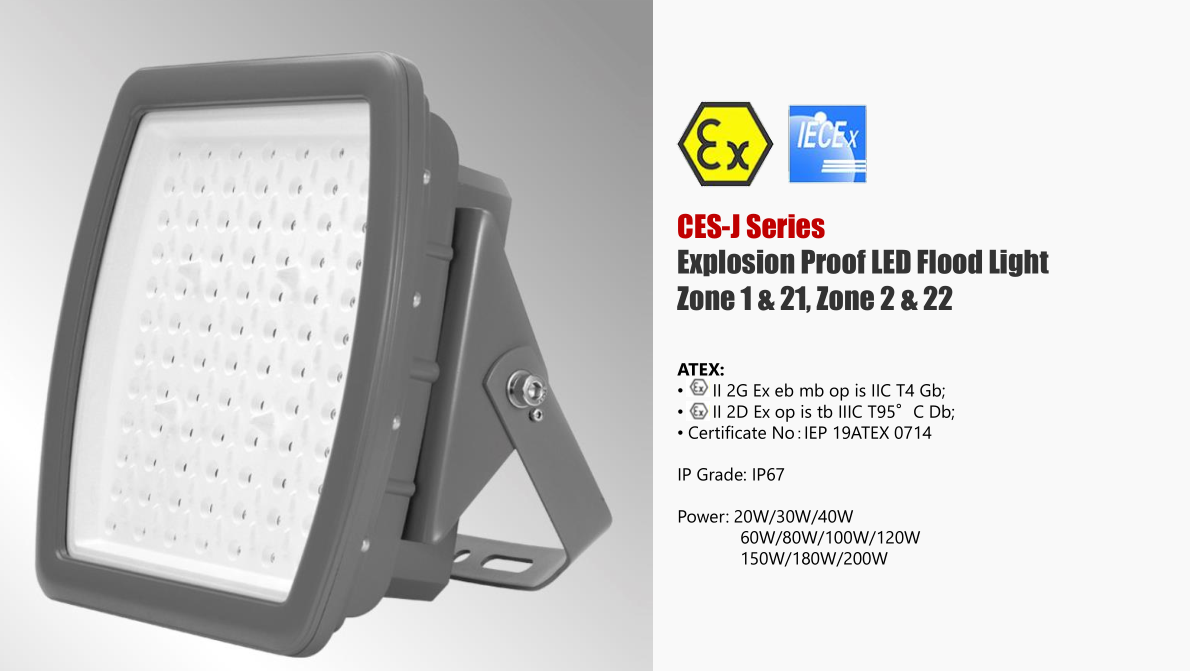
CES-J explosion proof led floodlight with ATEX\IECEX/UL certification, which can be used in wastewater treatment, oil refineries, drilling platforms, petrochemical facilities, catering facilities, tunnels, outdoor walls and anchors The general area lighting installed, as well as hazardous areas with flammable steam and gas, is an explosion-proof floodlight with high lumen and high luminous efficiency, designed to meet the requirements of applicable hazardous gas areas, and the working environment with a temperature as high as 40°C , Can also work in humid environment, IP rating is IP66.
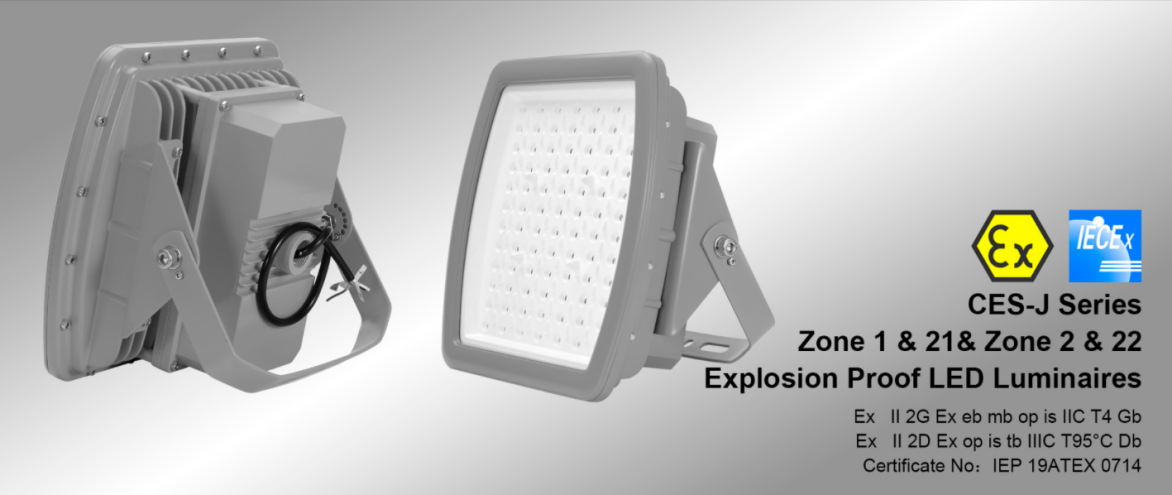
The shell is made of a die-cast aluminum shell with a special process, and the powder coating is added to make the explosion-proof lamp have a high-strength hard shell and corrosion resistance. At the same time, the appearance is also excellent. The excellent three-dimensional heat dissipation structure design increases the lamp The efficiency and service life can withstand high mechanical strength and temperature changes. The lamp has a built-in ballast, no need to be equipped with a ballast box, and the lamp body and the ballast box are designed separately, with a compact structure to ensure the explosion-proof performance of the shell.
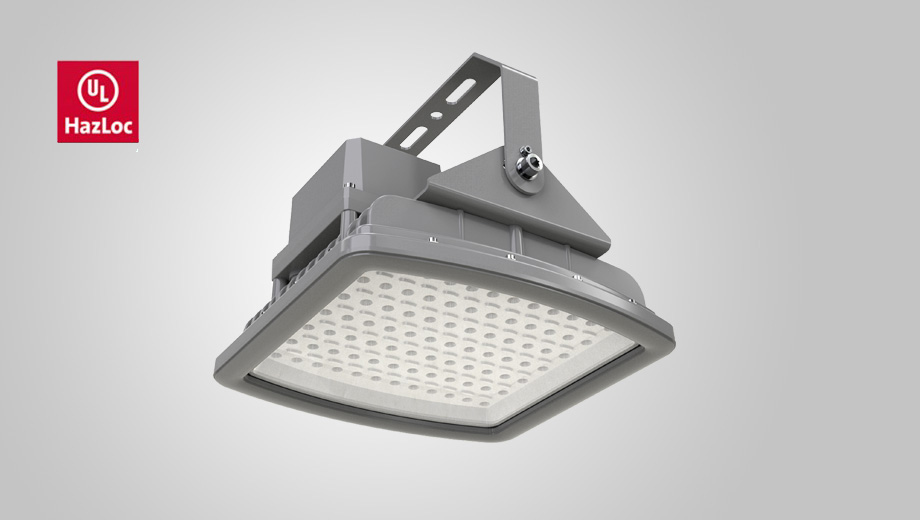
Although his lamp beads have different powers, the number of lamp beads is also different, but his luminous flux is maintained at 110-140lm/W, and the color temperature and installation angle can be adjusted between 3000-6500K according to customer needs. This lamp There are also lighting solutions in dusty environments. If you have any needs in this area, you can contact us for consultation, or if you have other lighting consultations, you can also contact us to provide you with lighting solutions.
Published in
CESP Ex Wiki
Tagged under
Thursday, 27 May 2021 07:11
Hazardous Location Linear Light LED CES-EX-LN-02P
Published in
UL HazLoc Certificated LED Luminaires
Tagged under
Tuesday, 18 May 2021 02:01
How important is the division of explosion-proof areas?
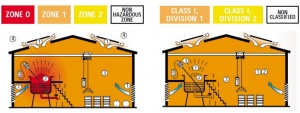
Explosive substances: some flammable substances are produced in many production sites.
Explosive substances exist in about two-thirds of coal mine sites. In the chemical industry, explosive substances exist in more than 80% of the production workshop area.
Oxygen: oxygen in the air is everywhere.
Ignition source: a large number of electrical instruments are used in the production process. Various frictional electric sparks, mechanical abrasion sparks, static sparks, high temperature, etc. Are inevitable, especially when instrumentation and electrical failures occur.
From an objective point of view, many industrial sites meet the explosion conditions. When the mixed concentration of explosive substances and oxygen is within the explosive limit range, if there is an explosion source, an explosion will occur. Therefore, it is necessary to take explosion protection.
And this article focuses on the division of hazardous location in zone and division systems
Note: this article is published by the CESP technology center in conjunction with the global explosion-proof standard system. If you have any questions, please contact us.
Explosion is a form of combustion. When the speed of the oxidation reaction reaches a certain level, the reaction instantly releases a large amount of heat, causing the gas to expand violently, forming a shock wave, and accompanied by sound. This phenomenon is explosion gas. Explosion gas is the result of rapid combustion. According to the explosion triangle principle: explosive substances, oxygen, and ignition sources, measures to eliminate electric sparks and dangerous high temperatures in electrical equipment including automation instruments will help prevent combustion and avoid the formation of explosions.
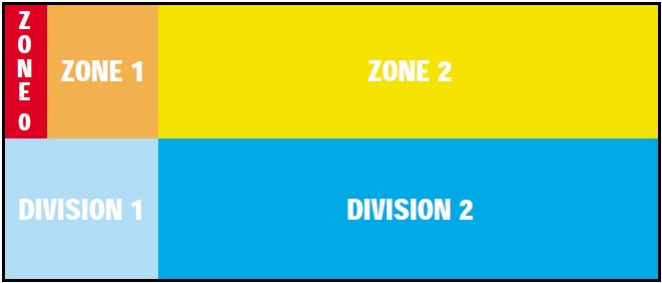
Therefore, hazardous locations are divided into different areas according to the frequency and duration of the explosive environment, and the equipment requires different explosion-proof levels. According to the different degree of danger (continuous danger/intermittent danger/danger under abnormal conditions), the division is the level of the dangerous zone coming out (zone 0/ 1/ 2; zone 20/21 /22; division 1 /2).
|
Area type |
Division system |
Zone system |
Definition |
Time definition |
|
Persistent danger |
Division 1 |
Zone0 / zone20 |
Places where explosive environment persists or exists for a long time |
Above 1000H/y |
|
Intermittent danger |
Division 1 |
Zone1 / zone21 |
Under normal circumstances, there may be places with explosive atmospheres |
1000H/y-10H/y |
|
Dangerous under abnormal conditions |
Division 2 |
Zone2 / zone22 |
Under normal circumstances, it is impossible to have an explosive environment, or even if it exists, it is a short-term place |
10H/y or less |
Note: 1H/y is regarded as a non-hazardous location.
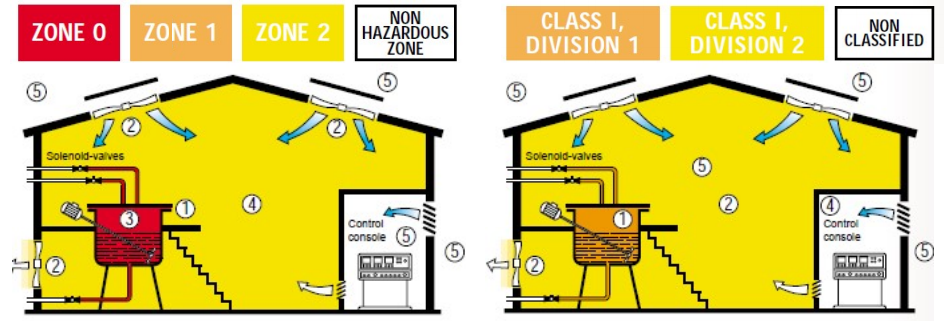
- The following are some examples of hazardous location divisions, for reference
- 1、Natural ventilation;
- 1、Division 1 Area;2、Division 2 Area;
- 2、Zone 0 area;
- 2、division 1 area
- 3、Zone 1 area;
- 3、electrical equipment must comply with division 1 nec/cec technical requirements and installation requirements;
- 4、Non-explosion-proof area;
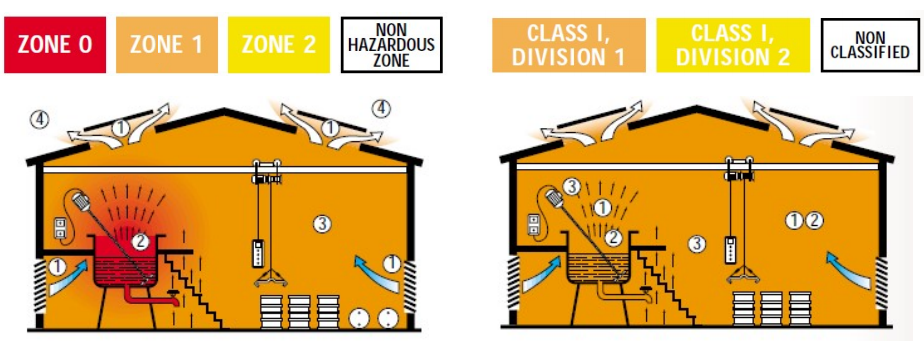
- 1、Cover The Reaction Tank 5、 Non-Explosion-Proof Area;
- 1、Division 2 Area;
- 2、Zone 0 Area;6、Mechanical Ventilation;
- 2、Transition Area Between Division 1 And Division 2
- 3、Zone 1 Area; 7、Products And Work Area
- 3、Products Are Stored In Division 1;
- 4、Zone 2 Zone; Separate Domains;
- 4、Non-Explosion-Proof Zone
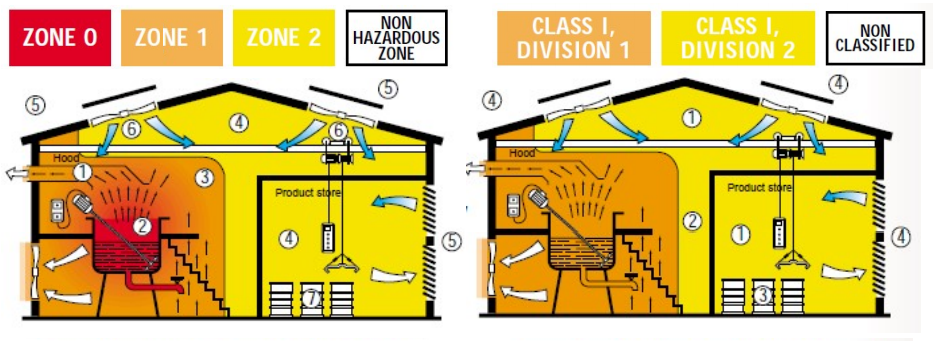
- 1、The Reaction Tank Is Completely Enclosed
- 1、Division 1 Area;2、Division 2 Area;
- 2、Mechanical Ventilation;
- 4、The control room of the ventilation/pressurization equipment
- 3、Zone 0 Area;
- is isolated as a non-hazardous area
- 4、Zone 2 Area;
- 5、Electrical Equipment Must Meet The Technical Requirements And
- 5、Non-Explosion-Proof Area
- Installation Requirements Of Division 2 In NEC/CEC;
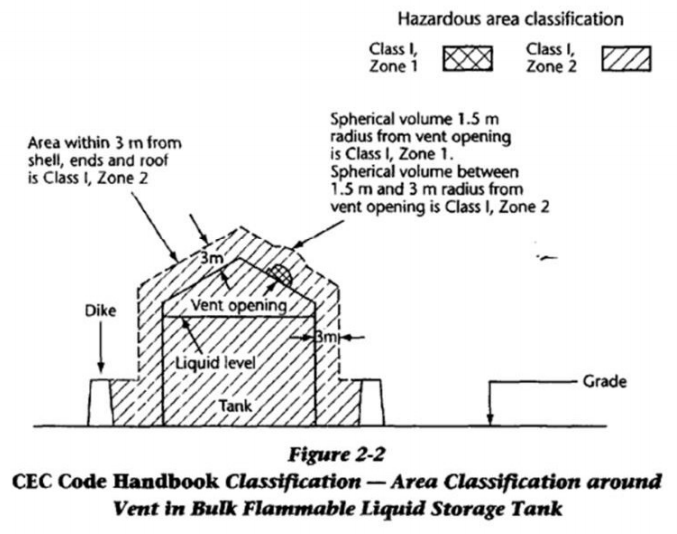
Tanker truck division of explosion hazardous location when unloading gasoline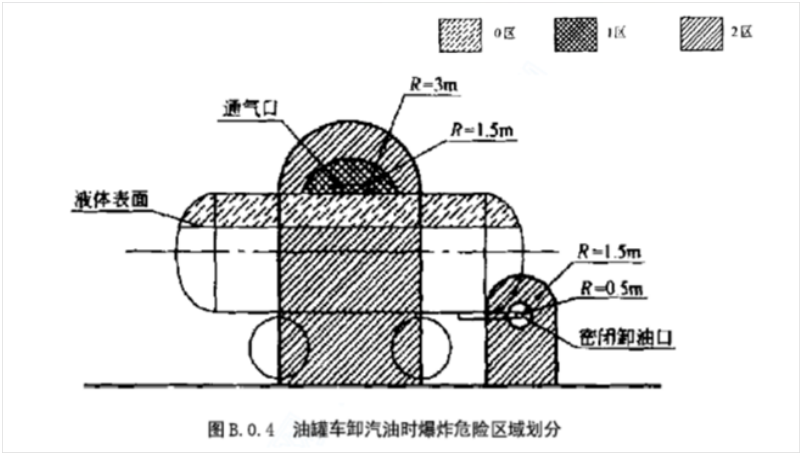
North American explosion-proof electrical installation
Canada: Canadian electrical code
US : national electrical code –NFPA 70
Installation method:
Conductors in rigid conduit
Conduit connection
Non armored cable
Non-Armoured cable
Armored cable
Armored cable
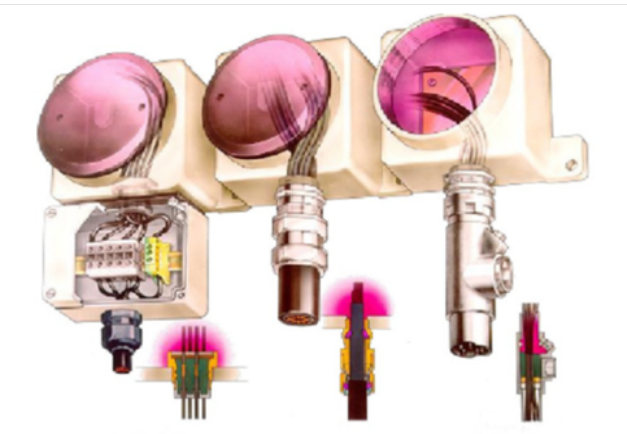
Ex d +ex e junction box cable entry pipeline entry
(ex e gland seal) +ex d gland seal +sealing device
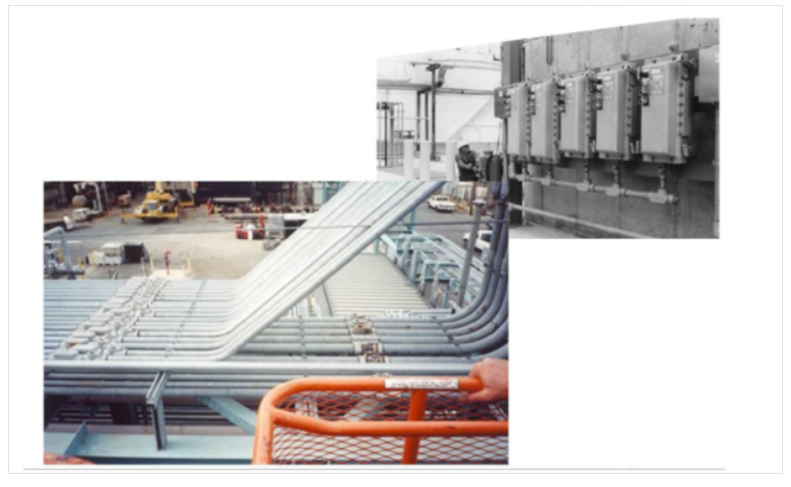
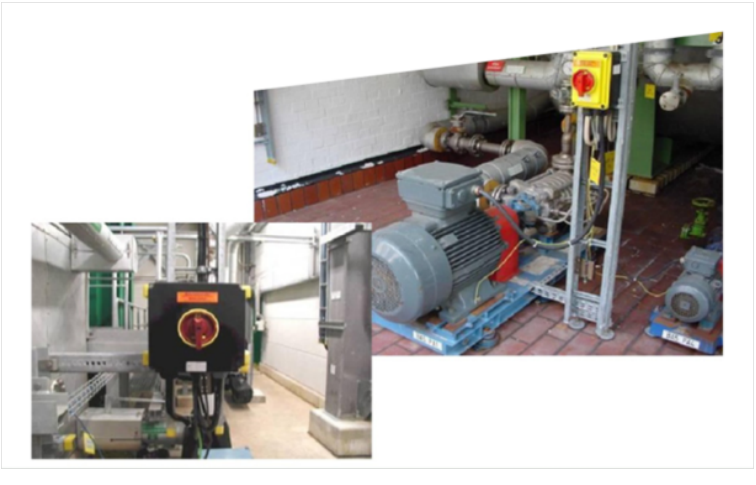
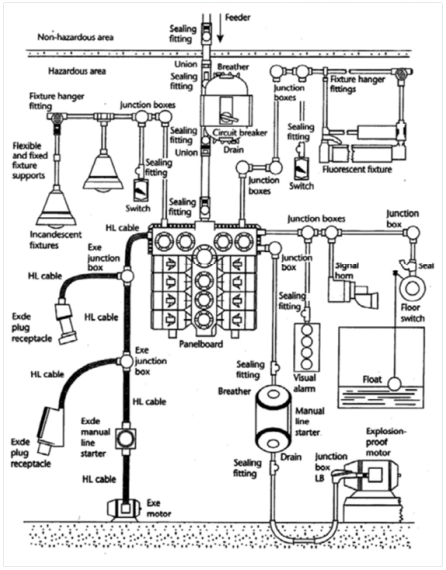
In order to ensure the safety of personnel and the normal operation of production, explosion-proof electrical equipment should be selected in strict accordance with corresponding standards in hazardous locations. Only reasonable selection, correct installation and necessary maintenance can ensure production safety.
Published in
CESP Ex Wiki
Tagged under
Tuesday, 11 May 2021 07:29
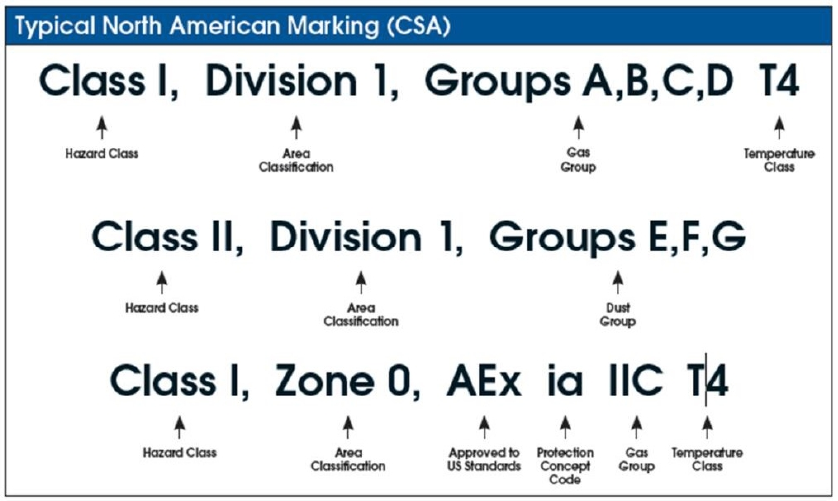
Explosion-proof mark explanation
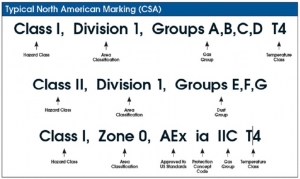
This article mainly explains the global explosion-proof mark and explosion type, including the North American division system explosion-proof mark, Europe and the international zone system explosion-proof mark, it is not only suitable for explosion-proof lamps, but also for other explosion-proof equipment products.
Note: This article is authoritatively published by CESP Explosion-proof Technology Center, for reference only, if you have any contact, please contact us.
Typical North American Marking (CSA)
Definition of Hazardous Locations - North America
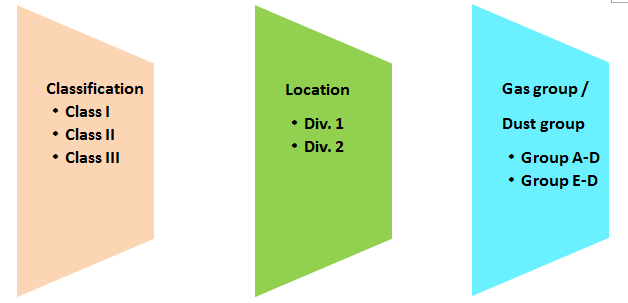
Classification of Regional Explosive classification
|
Class I ·Flammable gas, vaporization or liquid substance Class II ·Combustible dust |
Class I Division/Zone Area
Explosive gas application Location comparison table
|
Division 1 Flammable or explosive substances in a normal environment, or the presence of recurrent |
Zone 0 Flammable or explosive substances in a normal environment for a long time or continuous presence Zone 1 Flammable or explosive substances may be present in a normal environment |
|
Division 2 Flammable or explosive substances are extremely unlikely to exist in a normal environment |
Zone 2 Flammable or explosive substances are extremely unlikely to exist in a normal environment |
Class I Division/Zone
Explosive gas group classification table
|
Division 1 and 2 |
Zone 0, 1 and 2 |
|
A (acetylene) |
IIC (acetylene & hydrogen) |
|
B (Hydrogen) |
|
|
C (Ethylene) |
IIB (Ethylene) |
|
D (propane) |
IIA (propane) |
Class I Division/Zone
Explosive dust group classification table
|
Division 1 and 2 |
Zone 20, 21 and 22 |
|
Metal dust |
IIC (Carbonaceous dust) |
|
F (Carbonaceous dust) |
IIB (Non-conductive dust) |
|
G (Non-conductive dust) |
IIB (Non-conductive dust) |
|
IIA (combustible flyings) |
|
Division |
||
|
Class I Explosive gas |
Group D |
Gas (coal mine) |
|
Group D |
Propane |
|
|
Group C |
Ethylene |
|
|
Group B |
Hydrogen |
|
|
Group A |
Acetylene |
|
|
Class II Explosive dust |
Group E |
Metal Dust |
|
Group F |
Black charcoal /Coal/Coke Dust |
|
|
Group G |
Grain dust |
|
|
Class III flyings |
||
Division System (Class II & Class III Dust)
|
Explosion-proof type |
Mark |
Location |
|
Dust Ignition Proof Dust Protected Pressurisation Pressurisation Intrinsic Safety |
DIP NI PX PY PZ IS |
Class II Division 1 Division 2 Division 1 Division 2 Division 1 |
|
Fiber & Flying Protection |
- |
Class III Division 1 & 2 |
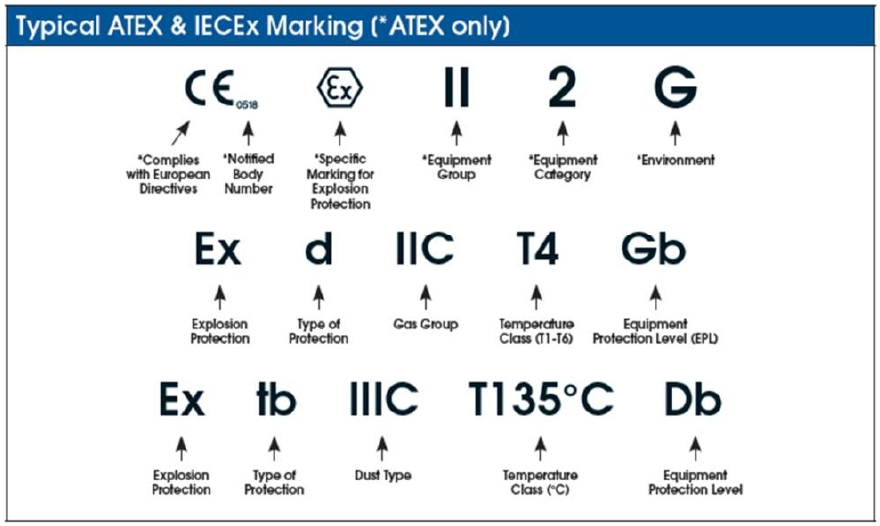
|
International - Zone |
|
|
Group I - Coal mine gas environment |
|
|
Group II Explosive atmospheres other than coal mines |
IIA Propane |
|
IIB Thylene |
|
|
IIC Hydrogen + Acetylene |
|
|
Group III Explosive dust environment other than coal mines |
IIIC Conductive dust |
|
IIIB Non-conductive dust |
|
|
IIIA Flammable flyings |
|
|
North American Zone system |
ATEX |
IECEx |
ATEX |
Operating conditions |
|
Ma |
Ma |
Ma |
M1 |
The device still operates when an explosive environment occurs |
|
Mb |
Mb |
Mb |
M2 |
When an explosive environment is present, the device is powered off |
|
Ga |
Ga |
Ga |
1G |
Still running in Zone 0/1/2 |
|
Gb |
Gb |
Gb |
2G |
Still running in Zone 1/2 |
|
Gc |
Gc |
Gc |
3G |
Still running in Zone 2 |
|
Da |
Da |
Da |
1D |
Still running in Zone 0/1/2 |
|
Db |
Db |
Db |
2D |
Still running in Zone 21/22 |
|
Dc |
Dc |
Dc |
3D |
Still running in Zone 22 |
Note: the North American Division system does not have the concept of EPL equipment protection level
Zone System(Gas)
|
Explosion-proof Type |
Mark |
Equipment Protection Level |
|
Intrinsic safety ”i” Encapsulation ”m” |
Ex ia Ex ma |
Ga Ma Ga Ma |
|
Flame Enclosure ”d” Intrinsic safety ”i” Increase safety ”e” Pressurized ”p” Oil immersion ”o” Encapsulation ”m” Power Filling ”q” |
Ex d Ex ib Ex e Ex px Ex py Ex o Ex mb Ex q |
Gb Mb Gb Mb Gb Mb Gb Mb Gb Mb Gb Mb Gb Mb |
|
Intrinsic safety ”i” ”n” Type Encapsulation ”m” |
Ex ic Ex nL Ex nA ExnC Ex nR Ex mc |
Gc Gc Gc |
Zone System(Dust)
|
Explosion-proof Type |
Mark |
Equipment Protection Level |
|
Dust Ignition Protection by Enclosure ”ta” Intrinsic safety ”i” Encapsulation ”m” |
Ex ta Ex ia Ex ma |
Da Da Da |
|
Flameproof Enclosure ”tb” Intrinsic safety ”i” Pressurized Enclosure ”p” Encapsulation ”m” |
Ex tb Ex ib Ex p Ex mb |
Db Db Db Db |
|
Dust Ignition Protection by Enclosure ”tc” Intrinsic Safety ”i” Encapsulation ”m” |
Ex tc Ex ic Ex mc |
Dc Dc Dc |
|
Zone System Group II |
Division System Class I |
Maximum surface temperature / ⁰C |
|
T1 |
T1 |
450 |
|
T2 |
T2 |
300 |
|
T2A |
280 |
|
|
T2B |
260 |
|
|
T2C |
230 |
|
|
T2D |
215 |
|
|
T3 |
T3 |
200 |
|
T3A |
180 |
|
|
T3B |
165 |
|
|
T3C |
160 |
|
|
T4 |
T4 |
135 |
|
T4A |
120 |
|
|
T5 |
T5 |
100 |
|
T6 |
T6 |
85 |
Note: The Max. surface temperature of Zone Group I is 150⁰C or 450⁰C.
Published in
CESP Ex Wiki
Tagged under
Tuesday, 11 May 2021 02:06
Global Explosion-Proof Standard Introduction
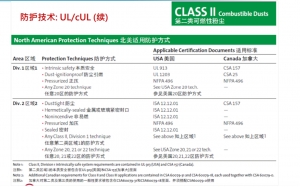
Product standards are usually based on international, regional, national, industry, and enterprise. This article focuses on introducing national and alliance standards of explosion proof luminaires.
Note: This article is published by the CESP Technology Center in conjunction with the global explosion-proof standard system. If you have any questions, please contact us.
National standards:
- China GB
- German DIN
- Canada CAN
- British BS
Regional standards:
- European Community Standard (CEN)
- European Committee for Electrotechnical Standardization (CENELEC)
International level standards:
- International Organization for Standardization (ISO)
- International Electrotechnical Commission (IEC)
The standards usually implemented by our explosion-proof lamps include:
- Chinese national standard GB
- S. nationally recognized UL
- Canadian National Standard CSA
- EN recognized within the European Union
- IEC issued by the National Electrotechnical Commission
According to the different explosion-proof systems, the global explosion-proof luminaires are also divided into two categories: Zone system standards and Division system standards. Among them, the parent standard of the Zone system is the IEC 60079 series of standards, and other standards are equivalent, modified, and directly quoted based on it as the parent standard.
Zone system:
- China-GB 3836 series
- International -IEC 60079 series
- Europe-EN 60079 series
- Canada-CSA 60079 series
- United States-UL 60079 series, ISA 60079 series
- GB 12476 series (dust)
- IEC 61241 series (dust)
Division System:
- UL 1203
- UL 913
- ISA 12.12.01
- NFliA 496
- FM3615
- FM3610
- FM3611
- FM3616 etc.
- Exlilosion-liroof standards for sliecific liroducts
American
- CSA 30
- CSA 157
- NFliA 496
- CSA 213
- CSA 25 etc.
- Exlilosion-liroof standards for sliecific liroduct
Canada
Explosion-proof standards of UL involving specific products:
- UL 783-Electric Flashlights and Lanterns for Use in Hazardous (Classified) Locations
- UL 844-Standard for Safety Luminaires for Use in Hazardous (Classified) Locations
- UL 674-Standard for Safety Electric Motors and Generators for Use in Hazardous (Classified) Locations
- UL 2225-Standard for Safety Cables and Cable-Fittings For Use In Hazardous (Classified) Locations
- UL 823-Electric Heaters For Use In Hazardous (Classified) Locations
- UL 121203-Portable Electronic Products Suitable for Use in Class I and II, Division 2, Class I, Zone 2 and Class III, Division 1 and 2 Hazardous (Classified) Locations
- UL 894-Switches for Use in Hazardous (Classified) Locations ( UL1203 replaced)
- UL 1207-Sewage Pumps for Use in Hazardous (Classified) Locations (replaced by UL674)
CSA related to the explosion-proof standards of specific products
- 2 No. 137-M1981 (R2014), Electric luminaires for use in hazardous locations
- 2 No. 145-11, Electric motors and generators for use in hazardous (classified) locations
- 2 No. 159-M1987 (R2014), Attachment plugs, receptacles, and similar wiring devices for use in hazardous locations: Class I, Groups A, B, C, and D;
- Class II, Group G, in coal or coke dust, and in gaseous Mines
- 2 No. 174-M1984 (R2012), Cables and cable glands for use in hazardous locations
The following regulation are from North American authoritative explosion-proof structures for your reference.
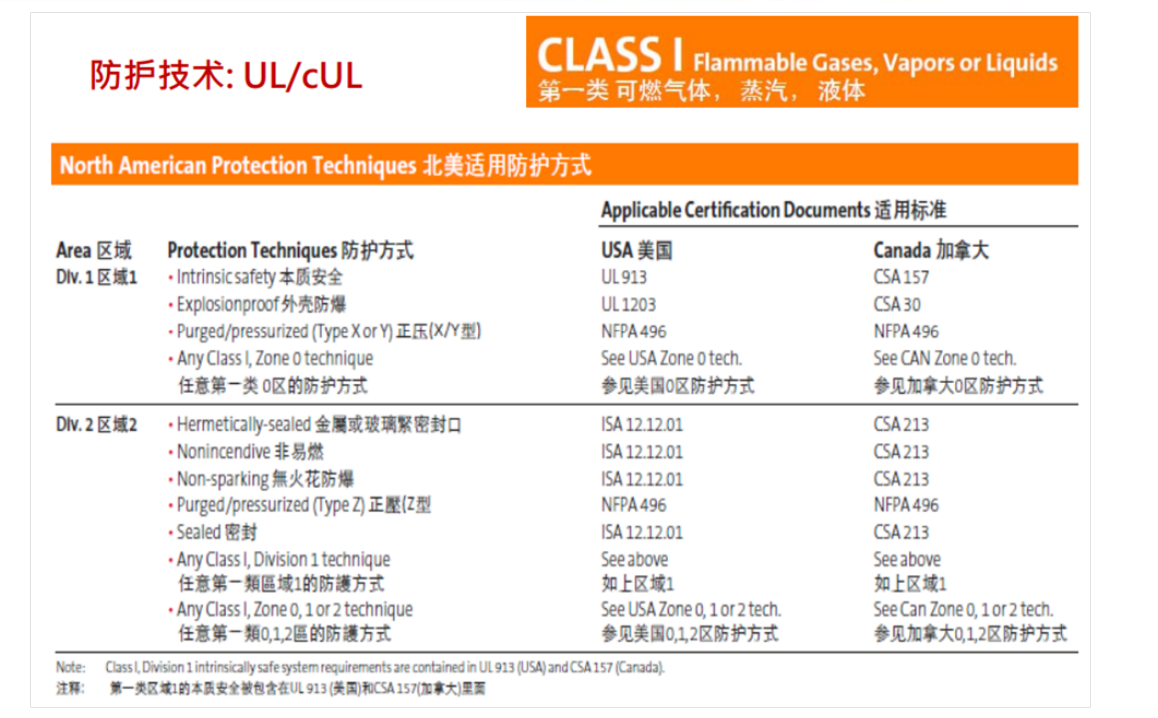
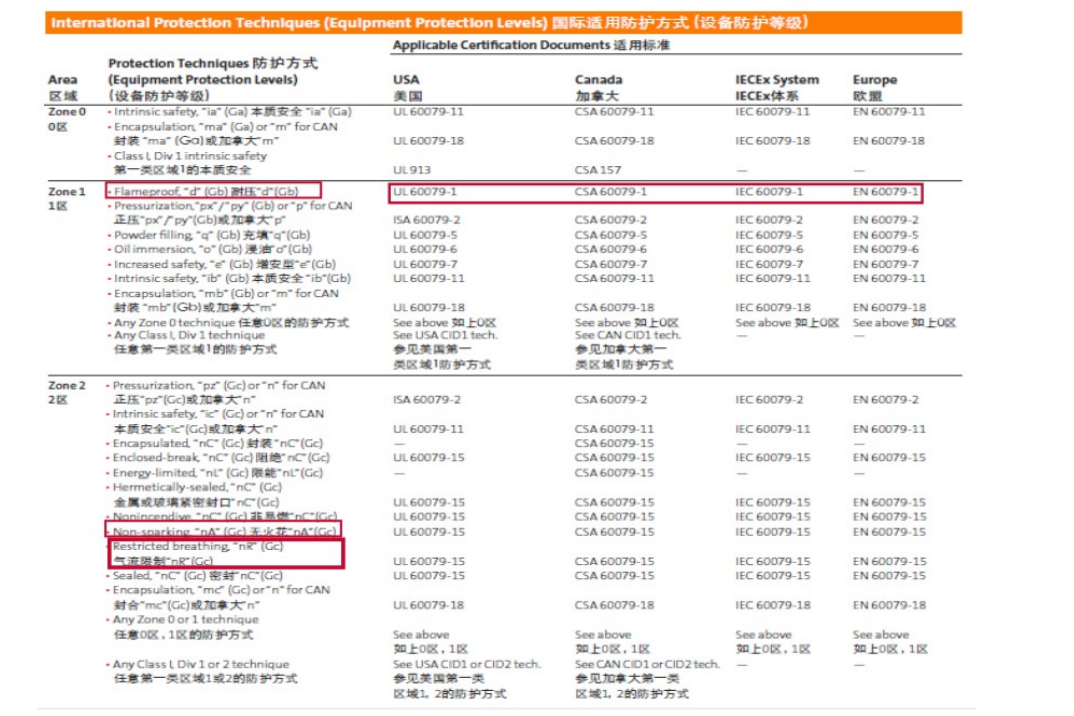
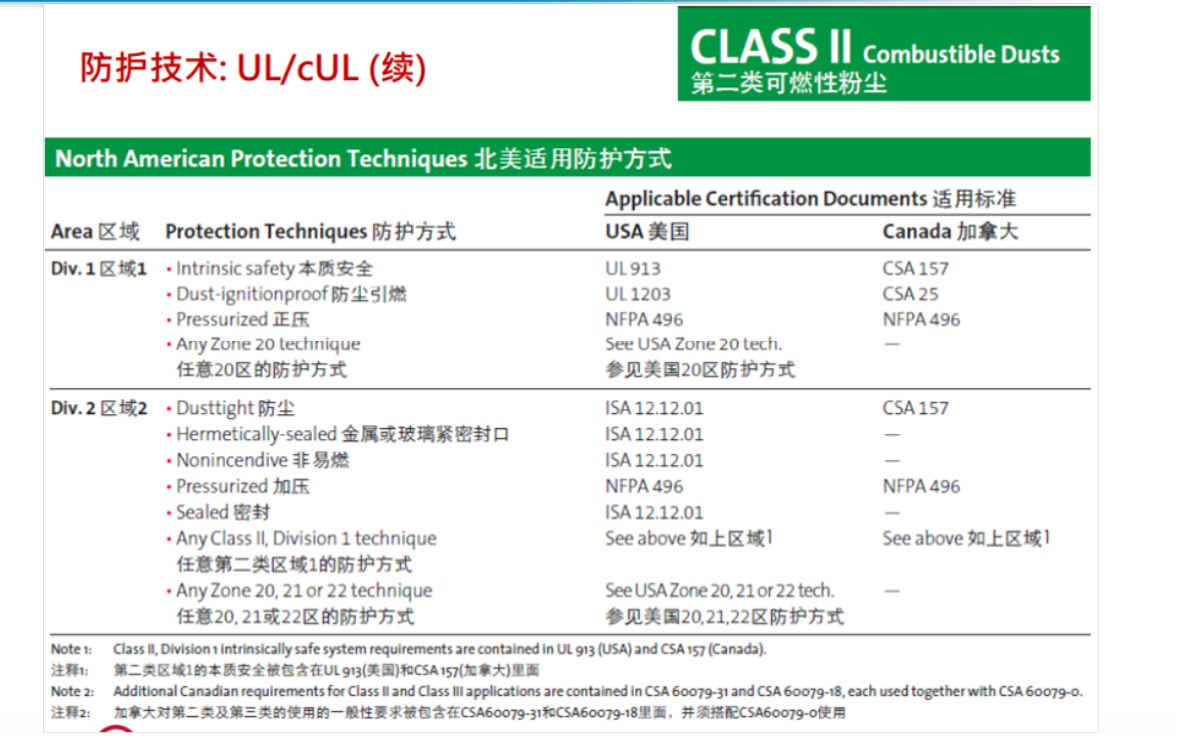
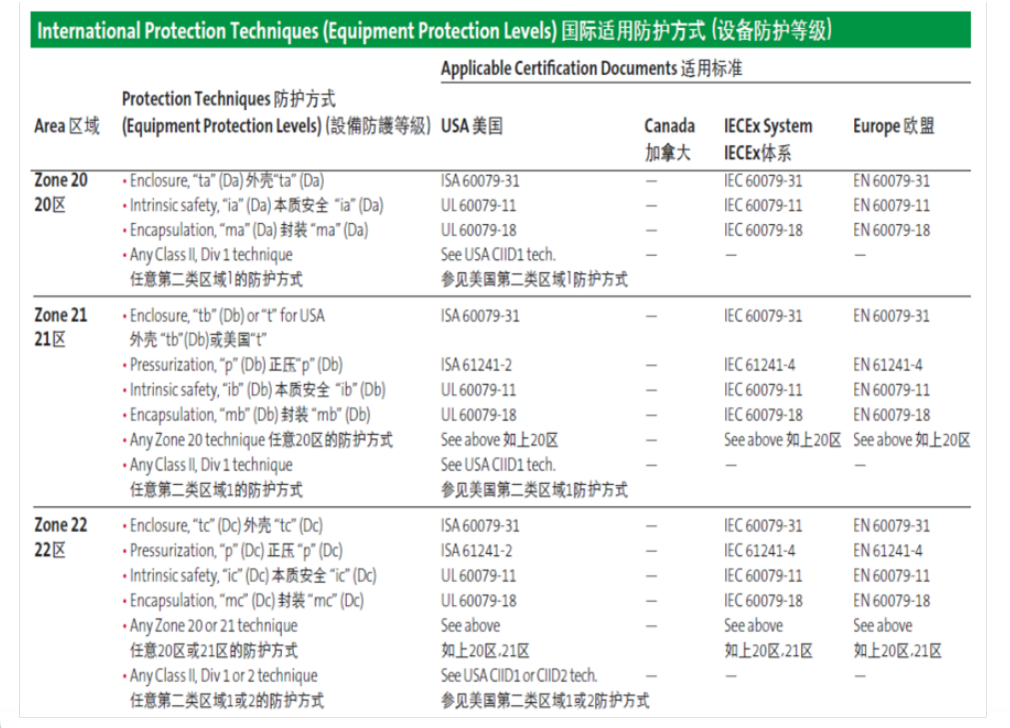
The following regulation are from International and European authoritative explosion-proof structures for your reference.
ATEX & IECEx
- IEC/EN 60079-0
- IEC/EN 60079-1
- IEC/EN 60079-2
- IEC/EN 60079-5
- IEC/EN 60079-6
- IEC/EN 60079-7
- IEC/EN 60079-11
- IEC/EN 60079-15
- IEC/EN 60079-18
- IEC/EN 60079-28
- IEC/EN 6007931
Standard
- General Requirement
- Flameproof Enclosure
- Pressurized Enclosure
- Power Filling
- Oil lmmersion
- Increased Safety
- Intrinsic Safety
- Type of Protection
- Encapsulation
- Transmission Systems Using Optical Radiation
- Dust Ignition Protection by Enclosure
Protection Technique
- --
- “d”
- "p"
- "q"
- "o"
- "e"
- "i"
- "n"
- "m"
- --
- "t"
Protection Technique
Published in
CESP Ex Wiki
Tagged under
Monday, 10 May 2021 01:33
What's the advantage of CES-SC Explosion proof LED Hand Lamp?
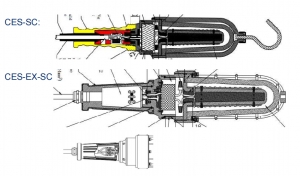
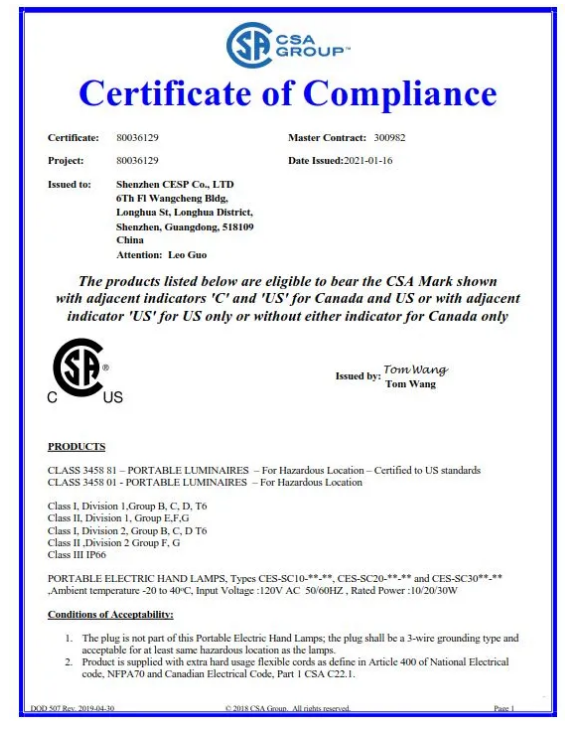
CESP explosion-proof LED portable hand lamp was designed in 2019. After continuous modification and testing, it got European ATEX and IECEx Certtificate Zone 1 Zone 21 in 2020. It also have obtained Class 1 Division 1 & 2 Explosion-proof certified (CSA 137 and UL 844 Standard) by CSA Group in January 2021.
As the first explosion-proof system standard of North American Class 1 Division 1 flameproof LED explosion-proof hand lamp in the world, CSA Group Kunshan Laboratory held a certificate ceremony on January 27, 2021, it means a major breakthrough of CESP in the global explosion-proof field .
1. Introduce of CES Explosion proof LED Hand Lamp
Structural design: The lamp body of the SC series explosion proof LED hand lamp is made of high-strength VO grade rubber handle and ADC12 aluminum alloy and equipped with low-carbon steel wire, which helps to reduce weight and improve durability.
Material: The housing is made of high-strength tempered glass (10mm), which has been tested by internal pressure and hydraulic pressure. The anti-corrosion grade is WF2, IP grade is up to IP67, and it can withstand 7J pressure.
Optical design: use high-quality LM80 certified LED chips, with a luminous efficiency of up to 130LM/W. For example, 30W explosion proof handlamp can reach to 3900 lumen flux, and with a 180° or 360° beam angle to meet all-round lighting.
In general, CES-SC explosion proof safety hand lamp is beautiful and simple in appearance, and convenient to operate, can be hand-held, placed on a table, magnetically attracted, and suspended for lighting. As the explosion proof hand lamp is very light and small, it can provide portable lighting for hazardous locations and temporary projects. It is very suitable for close work and inspection activities in hazardous areas where require explosion protection, such as quick plant turnarounds, MRO projects, oil fields, marine sites and tank cleaning etc.
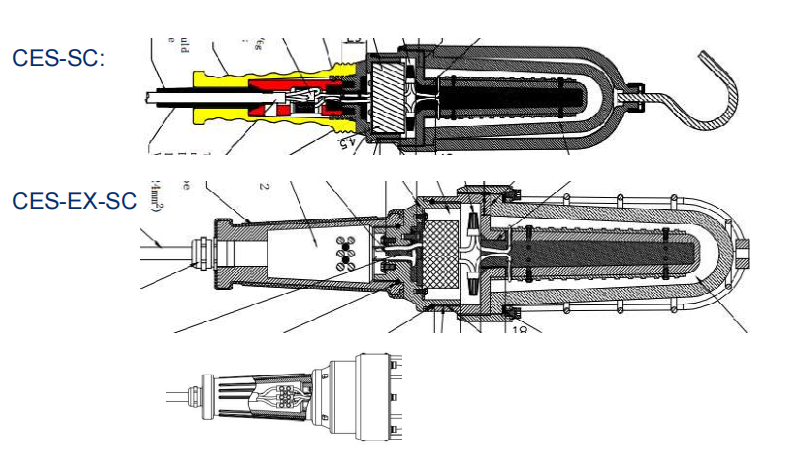
Schematic
2. Key benefit: Compare with existing explosion-proof hand lamps or traditional portable explosion proof lamp on the market.
List.1 - At present, there are very few explosion-proof led hand lamps that can meet the requirements of class 1 division 1 in the market. The traditional explosion proof hand lights are mostly with bulb. CESP-SC series explosion proof led hand light conform to Class 1 Division 1, Class II Division 1, Class 1 Division 2, Class II Division 2, Class III, and uses high lumen LED chips, that’s a safe and efficient explosion-proof lighting fixture.
List.2 - Most of the explosion proof portable lamp are low-power or increased safety on the market, but CESP explosion-proof hand lamps are designed to be flameproof type, which is nore sfety and reliale.
List.3 - Compared with other portable explosion proof work light, this explosion proof portable hand lamp has the same volume, but can up to 30W. In additional, CESP explosion proof hand lamps adopts the rubber material, which has good heat insulation performance and is more comfortable to use.
List.4 - The CESP explosion proof led hand lamp has passed the full-angle drop test, make sure safe and reliable. It also has passed the cable tightening test to ensure the safety during mis-operation.
3. The difference between Division hand light and Zone hand light:
Due to different market certification standards, CESP has made two version of products in order to meet the needs of the Global market. It divided into CES-SC and CES-EX-SC, which are Division system and Zone system respectively.
CES-SC series is an explosion-proof hand lamp with UL certification for Division system, which can be used in Class 1 Division 1, Class 2 Division 1, Class 1 Division 2, Class 2 Division 2, Class 3 hazardous location.
CES-EX-SC series is an increased safety and flameproof enclosure explosion-proof lamp with ATEX and IECEx for the Zone system. It can be used in hazardous environments such as Zone 1&21, Zone 2&22.
You can see the points as the below table,
| CES-SC | CES-EX-SC | |
| Dimension | Φ101.5 x 517mm | Φ101.5 x 516.5 mm |
| Protection Grillle | ADC12 - Spray Paint | |
| Handheld | V0 grade - plastic handheld | ADC12 housing with outer V0 grade rubber handle |
| Terminal | pressure welding terminal | screw terminal |
| Cable Gland | None | M20*1.5 with ATEX certificate |
| Cable | STW, UL Certified, 3*18AWG | IEC (CE) Certificate, outer diameter is 7mm |
| Glass | Tempered Glass (10mm) | |
| Change Line | Can change the line by the electrician | |
| Nameplate | stainless steel (rivet) | stailess steel (rivet or glue) |
| hazardous location | C1D1, C1D2, C2D1, C2D2, C2 | Zone 1/2/21/22 |
For specific parameters, you can view the product details page separately, or directly contact This email address is being protected from spambots. You need JavaScript enabled to view it. to ask the datasheet.
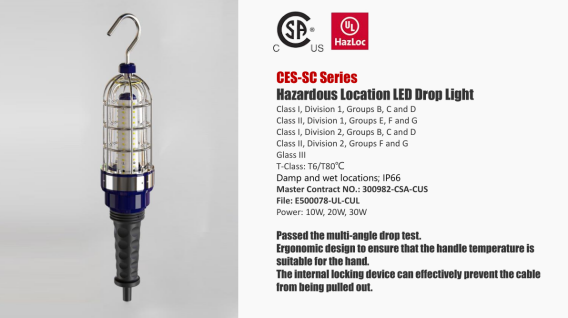
Class 1 Division 1 LED Hand Lamp
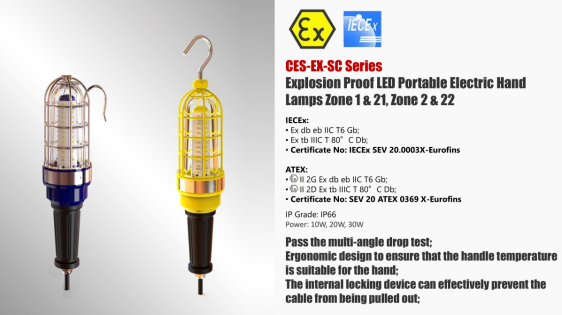
ATEX Explosion proof LED Hand Lamp
The following are the explosion-proof mark and some detailed information of the different standards of CESP explosion proof led hand light.
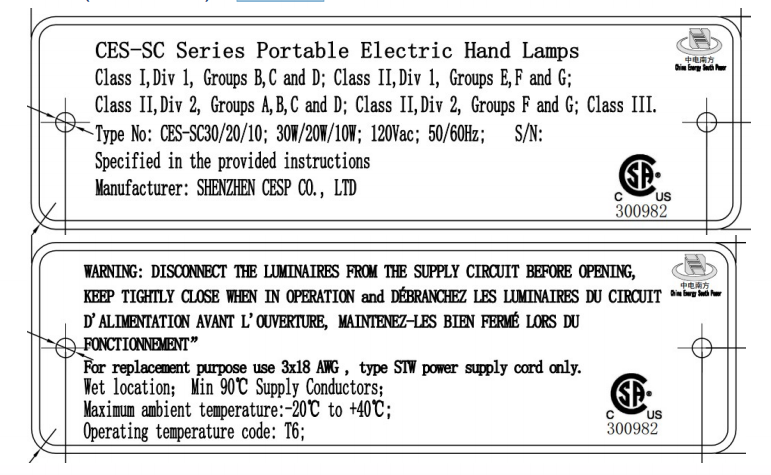
CES-SC(North American Division Standard Hazardous Location LED Hand Light)
Master Contract No: 300982-CSA-CUS
File: E500078-UL-CUL
Ex-proof mark:
- Class I, Division 1, Groups B, C and D;
- Class II, Division 1, Groups E, F and G
- Class I, Division 2, Groups A, B, C and D
- Class II, Division 2, Groups F and G
- Class III
- T-Class: T6 / T80°C
Parameters
|
Model |
Power (W) |
Output current (A) |
Input current (A) |
Luminous flux (LM) |
Light efficiency (Lm/W) |
LEDs Chip |
LEDs Type (3V,1W) |
Power Model |
Weights (kg) |
|
|
CES-SC30 |
30 |
0.8A |
0.26 |
3000 |
100 |
72Pcs |
3030 |
Unlisted Component (FKSZ3/9) SHENZHEN CESP CO. LTD (E500078) cat no. IAE30-220S36 |
2.4 |
|
|
CES-SC20 |
20 |
0.55A |
0.17 |
2000 |
100 |
72Pcs |
3030 |
|||
|
CES-SC10 |
10 |
0.25A |
0.09 |
1000 |
100 |
72Pcs |
3030 |
|||
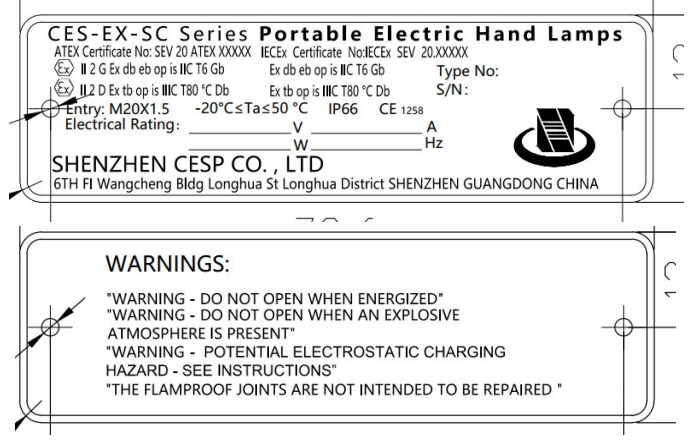
CES-EX-SC (ATEX / IECEx Zone Standard Explosion proof LED Hand Lamp)
IIECEx: IECEx SEV 20.0003X-eurofins
ATEX: SEV 20 ATEX 0369 X-eurofins
IECEx:
- Ex db eb IIC T6 Gb;
- Ex tb IIIC T 80°C Db;
- IP66;
ATEX:
- II 2G Ex db eb IIC T6 Gb;
- II 2D Ex tb IIIC T 80°C Db;
- IP66;
Parameters
|
Model |
Power (W) |
Input voltage (V) |
Output current (A) |
Input current (A) |
Luminous flux (LM) |
Light efficiency (Lm/W) |
LEDs Chip |
Power Model |
Weights (kg) |
|
CES-EX-SC30 |
30 |
AC 100V-277V |
0.8A |
0.3A-0.12A |
3000 |
100 |
72Pcs |
HTUC9-030W-01-71-0700; DC-1224-700; |
2.4 |
|
DC 110V |
0.28A |
||||||||
|
DC 12V-24V |
2.5A-1.25A |
||||||||
|
CES-EX-SC20 |
20 |
AC 100V-277V |
0.48A |
0.2A-0.08A |
2000 |
||||
|
DC 110V |
0.18A |
||||||||
|
DC 12V-24V |
1.7A-0.8A |
||||||||
|
CES-EX-SC10 |
10 |
AC 100V-277V |
0.23A |
0.1A-0.04A |
1000 |
||||
|
DC 110V |
0.09A |
||||||||
|
DC 12V-24V |
0.8A-0.4A |
||||||||
|
Note: Power model : HTUC9-030W-01-71-0700 (Input voltage AC100V-277V and DC110V) ; Power model : DC-1224-700(Input voltage DC12V-24V ). |
|||||||||
Detail of Nameplate
Product extension
- As an hanging mobile light
This hanging mobile lamp is a modified version of CES-EX-SC, built-in LED lamp beads, each mobile lamp has a plastic mesh cover, can provide protection for the closed bulb, the power is 10-30W, suitable for maintenance Lighting and work inspecte lights, etc., It is suitable for Maintenance lighting, working searchlights, etc., and you can also customize whether it is used for class 1 division 1 lights according to your needs.
- Power: 10W/20W/30W;
- Voltage: 100-277Vac/12-24Vdc/110Vdc;

- With Extension cord
With Extension cord is composed of plug, cable roller and hand lamp. It can be equipped with increased-safety plug and increased-safety cable roller according to your specific explosion-proof requirements for use in hazardous areas. If you do not have explosion-proof requirements, you can also equip with ordinary plugs and ordinary cables.
- Power: 10W/20W/30W;
- Voltage: 100-277Vac; 12-24Vdc; 110Vdc;
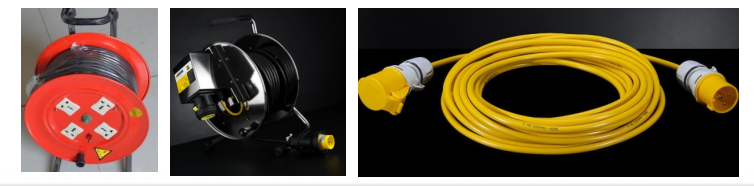
- With external mobile power box
External mobile power box including plugs, cable rollers and hand-held lights, it can be used in hazardous areas with increased-safety plugs and increased-safety power boxes according to your specific explosion-proof requirements.
If you don’t have explosion-proof requirements, you can also equip ordinary plugs and ordinary cable rollers. Used in a safe area, customization is acceptable.
- Power: 10W/20W/30W;
- Voltage: 100-277Vac/ 12-24Vdc/110Vdc;
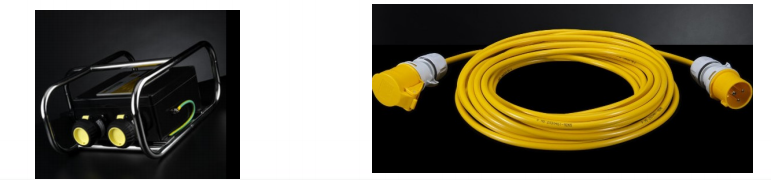
- As the explosion proof led string light
Explosion proof led string light including plugs, cables and explosion proof hand lights, it is composed of industrial-grade LED lights. It is made up of temporary LED strings connected to the power supply through an integrated 3-foot cable. Each light has a hook that allows the operator to hang these task lights overhead. Multiple light strings can be connected end to end to extend the work shop lighting.
- Power: 10W/20W/30W;
- Voltage: 100-277Vac / 12-24Vdc / 110Vdc;


Contact us to know more detail
Published in
CESP Ex Wiki
Tagged under
Saturday, 08 May 2021 03:54
Why CES-J Explosion proof LED Flood Lights?
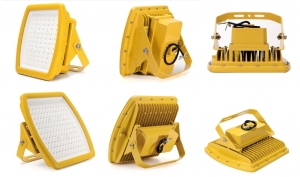
Explosion-proof LED floodlights, as one of the LED explosion-proof lighting fixtures, It takes various specific measures to prevent igniting the surrounding explosive mixture, such as explosive gas environment, explosive dust environment, methane gas, etc.
Generally, from the perspective of optical design, the flood light is a point light source that can illuminate uniformly in all directions. Its illumination range can be adjusted arbitrarily, and it is represented as a regular octahedron icon in the scene to illuminate the entire scene.
In the era of low-carbon and environmentally friendly lighting, LED explosion-proof floodlights are gradually replacing traditional explosion-proof lamps and are widely used in different hazardous area lighting places, including drilling platforms, offshore oil platforms, oil refineries, chemical plants, tunnels, Stations, oil depots, ships and other flammable and explosive fields, such as Zone 1 and Zone 2 explosive gas environments, and various indoor and outdoor operations and construction sites are used for fixed lighting.
CESP-J Explosion proof LED flood light is the first explosion-proof lamps of CESP, and it is also the first LED explosion-proof light in China to obtain the North American UL844 Class 1 Division 2 certification, then it obtained European ATEX and international IECEx Zone 1 explosion-proof certification.

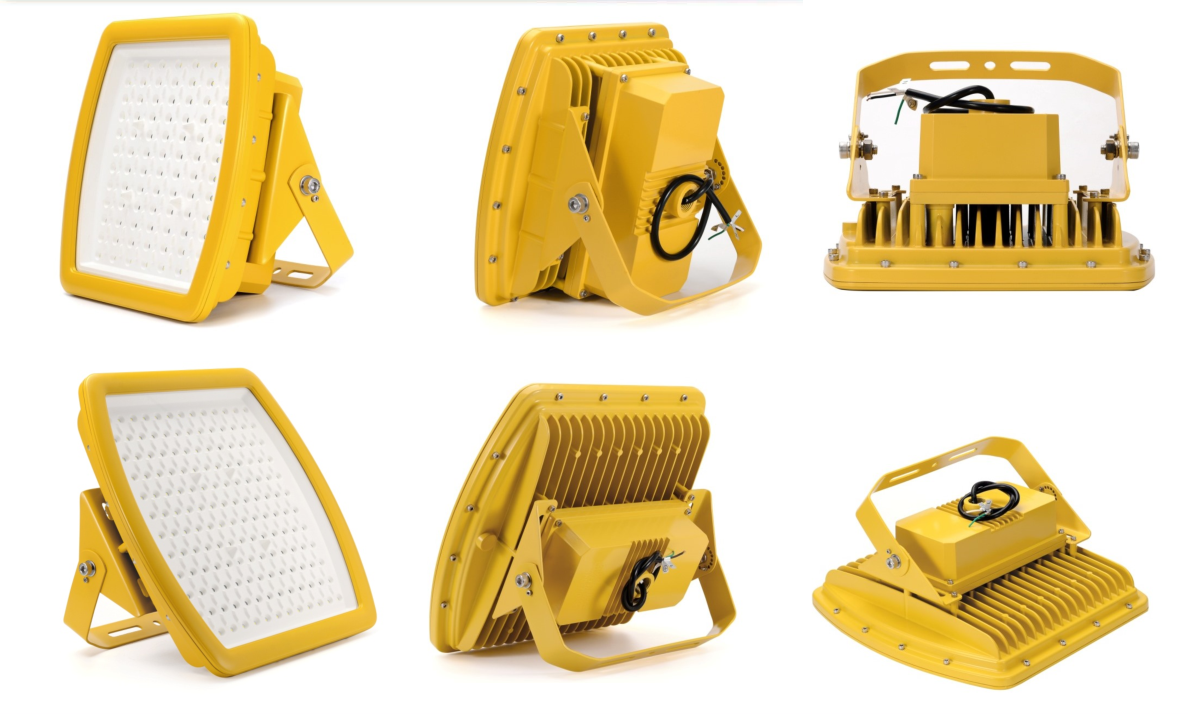
Let’s see the structural design!
Taking into account the particularity of the place where the lamp is used, when designing this explosion-proof LED floodlight, we adopted a special explosion-proof structural design. The power box, radiator and light source cavity are separated to achieve independent design to ensure its excellent heat dissipation. performance. The external wiring is connected by Gland, and 6mm tempered glass is used to make the lampshade, which can resist impact 6J. The shell is designed with die-cast aluminum and powder spraying process, which makes the performance of the finished LED floodlight relatively stable and has a certain explosion-proof Performance, it is very convenient to use, and the safety factor is very high.
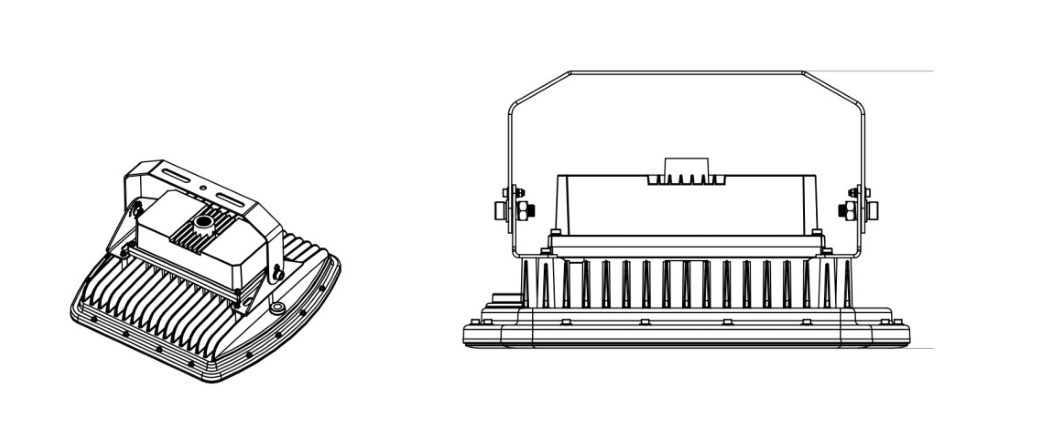
In additional, it has another bright spot is marine antiseptic. As we all know, many explosion-proof lights are used in marine lighting, including aircraft carriers, drilling & offshore platforms.
In 2017, due to the needs of the US Navy project, we have carried out special treatment on the lamps to meet the marine anti-corrosion standards, and obtained the North American UL1598A for marine certificate, which was successfully applied to the US Navy aircraft carrier lighting.
Certification Standard
|
Model No. |
CES-J (Explosion Proof LED Flood Light) |
|
Explosion System |
Zone、Division |
|
Hazardous Location |
Zone 1/ Zone 21/ Zone 2/ Zone 22; Class I Division 2; |
|
Certificate NO. |
ATEX: IEP 19 ATEX 0714- IEP IECEx: IECEx UL 18.0046-UL UL844: E475887-UL-CUL-Class I Division 2 |
|
Explosion Proof Mark |
ATEX · II 2G Ex eb mb op is IIC T4 Gb; · II 2D Ex op is tb op is IIIC T(95°C )Db; · Ta: -20°C ~ 40°C IECEx: · Ex ec IIC T4 Gc ·Ta:-40°C ~ 40°C UL: ·ClassI, Division2, GroupsA, B, C and D, T5 or T6; Max Temp:40°C |
Specification
|
Dimension |
200mm x 200mm x 147mm; 300mm x 300mm x 165mm; 400mm x 400mm x 169mm; |
|
Body Material |
ADC12-- Spray painting |
|
PC lampshade |
Tempered glass 4mm |
|
Wiring Terminals |
None |
|
Wiring Change |
Technicians can change wires by themselves |
|
Cable entry |
Standard: 3/4’’-14NPT (US standard) M25 X1.5 (European standard); M26 X1.5 can be selected |
|
Eectric cable |
European regulations: three-core rubber cable, IEC (CE) certification (standard with 0.5m wire); American regulations: STOW, UL certification, 3x18AWG (standard with 0.5m wire); |
|
Gland |
With ATEX certified gland-European standard; without gland-American standard |
|
Mounting |
U bracket: galvanized sheet-spray paint (stainless steel optional) |
|
Nameplate |
European regulations: stainless steel (rivets) American regulations: self-adhesive stickers |
|
Emergency Power |
Opotional |
Technology Parameter
|
Model |
CES-J (Class I Division 2) Hazardous Location LED Flood Light |
CES-J (ATEX-Zone 1/ Zone 21) Explosion proof LED Flood Light |
|
Input Voltage |
AC100V-277V; |
AC100V-277V; |
|
Power |
J40s: 200x 200mm: Max 45W J100: 300x 300mm: Max 105W J200: 400x 400mm: Max 200W |
200x 200mm:20W/30W/40W; 300x 300mm:60W/80W/100W; 400x 400mm:120W/150W/180W/200W |
|
Beam Angle/Light Efficacy |
200x 200mm:120° 118-122lm/W 300x 300mm:120 ° 120-130lm/W 400x 400mm: 120° 100-115 lm/W |
200x 200mm:90° 90° 115-120 lm/W 300x 300mm:90° 120-130 lm/W 400x 400mm:90° 120-130 lm/W |
|
CRI/CCT |
70/3000K-6500K |
70/3000K-6500K |
|
Power Supply |
Meanwell HLG Series (200W XLG240) |
Meanwell HLG Series (200W XLG240) |
|
Body Color |
Yellow / Grey |
Yellow / Grey |
For specific parameters, you can view the product details page separately, or directly contact This email address is being protected from spambots. You need JavaScript enabled to view it. to obtain the datasheet.
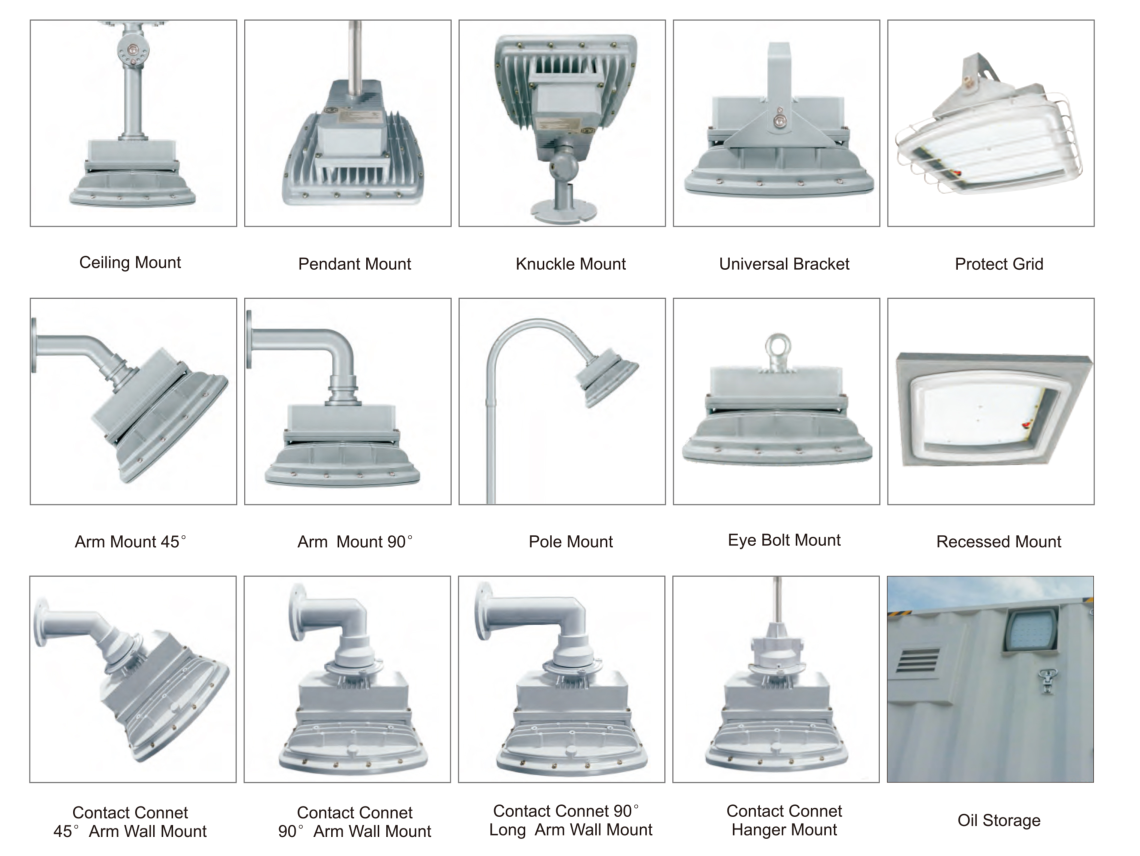
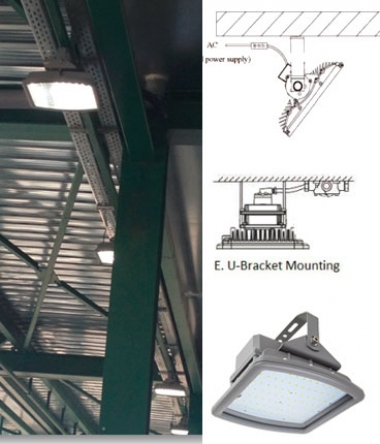
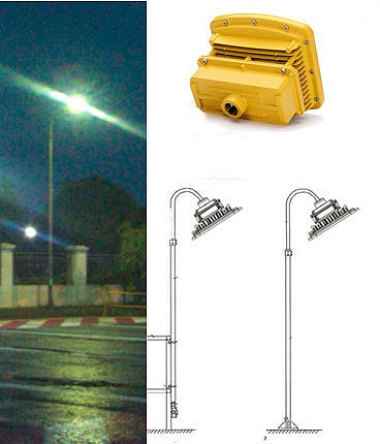
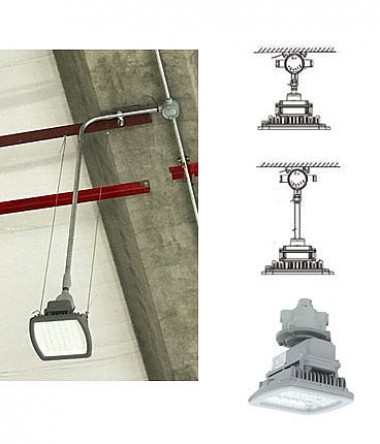
We also provide various installation methods to meet your needs.
About the extension of this LED explosion-proof flood light.
1. Emergency function
The product can increase the emergency function, which can be realized by adding an emergency power box.
Emergency specifications: 12W 1.5 hours/3 hours;
(Note: CES-J120, an emergency can be added for 120W or less, and 100W or less usually. Special plans for high-power lights emergency. Contact us for a plan)
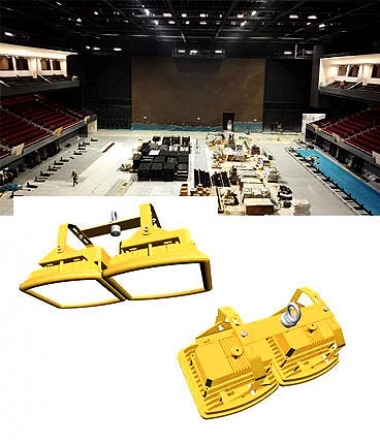
2. Double lamps
High-power lighting meets the needs of higher lighting scenes and can be assembled and produced.
Double lamps have passed the UL 3G vibration test. Choose the corresponding U bracket according to the customer's demand environment.
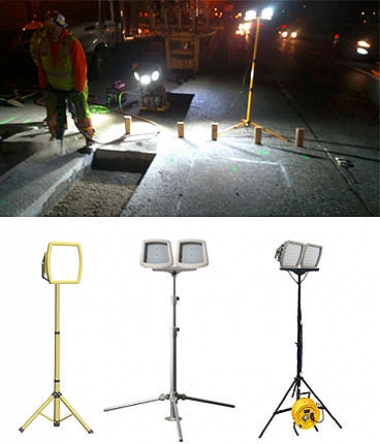
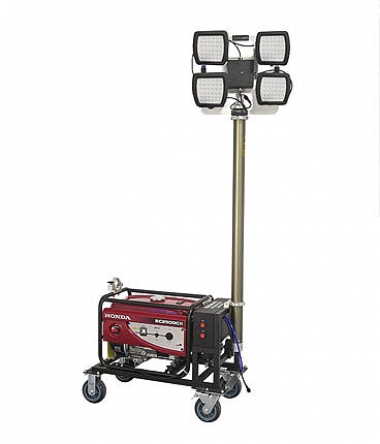
3. Mobile bracket lighting for hazardous location
By connecting with the mobile bracket, a mobile lighting fixture is formed, it can be connected to battery equipment or directly connected to the mains, and the corresponding power supply can be selected according to your requirements.
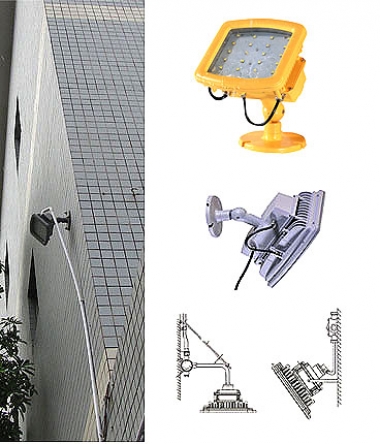
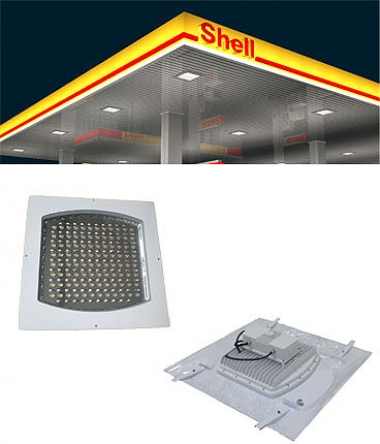
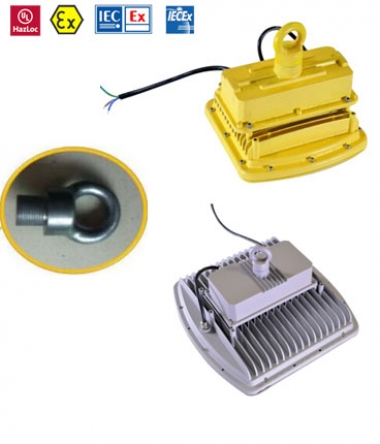
Published in
CESP Ex Wiki
Tagged under
Thursday, 05 April 2018 08:49
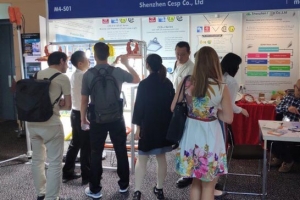
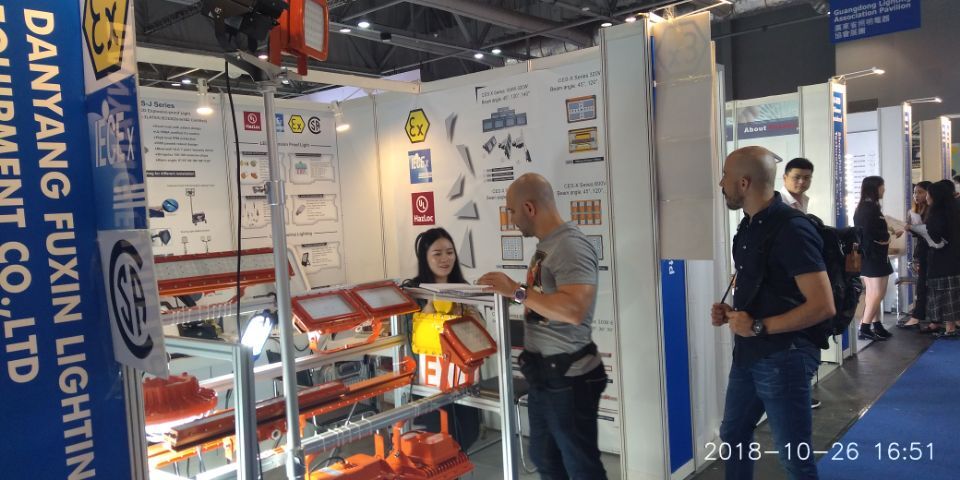
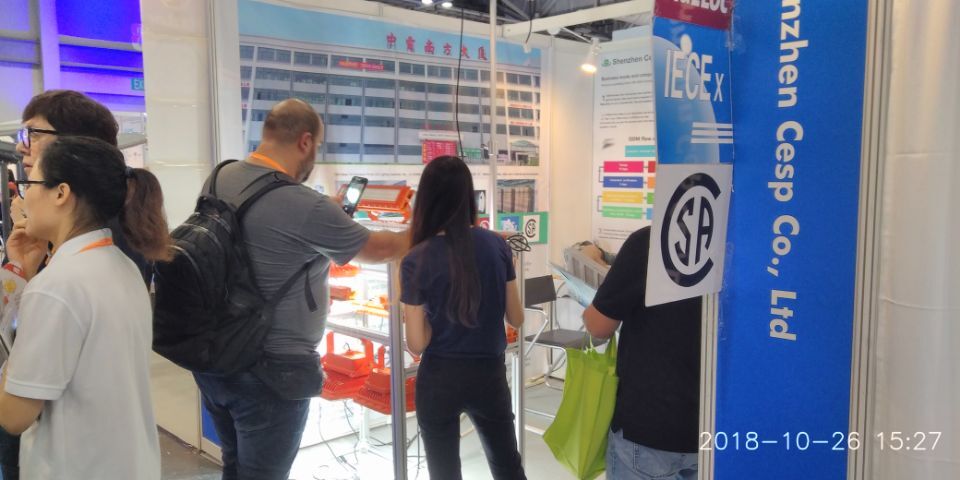
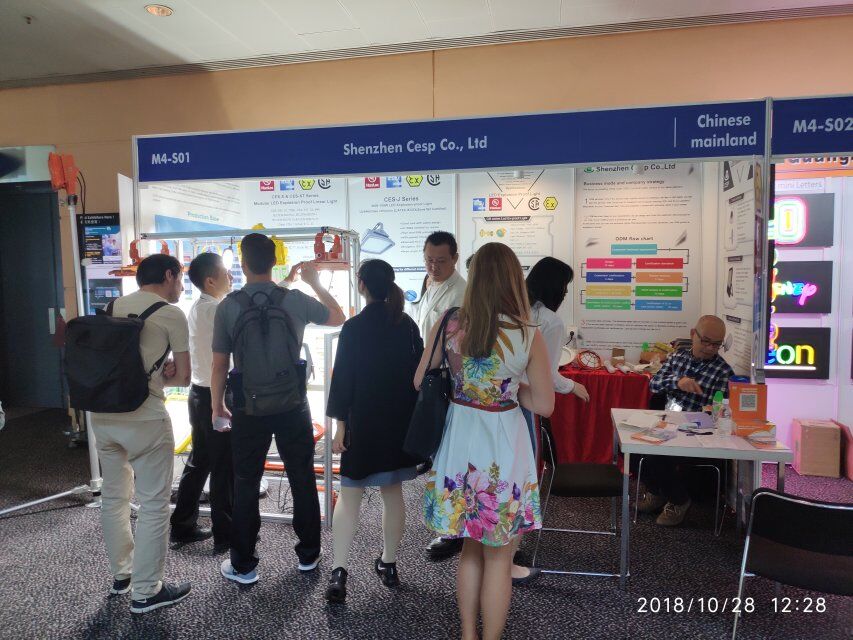
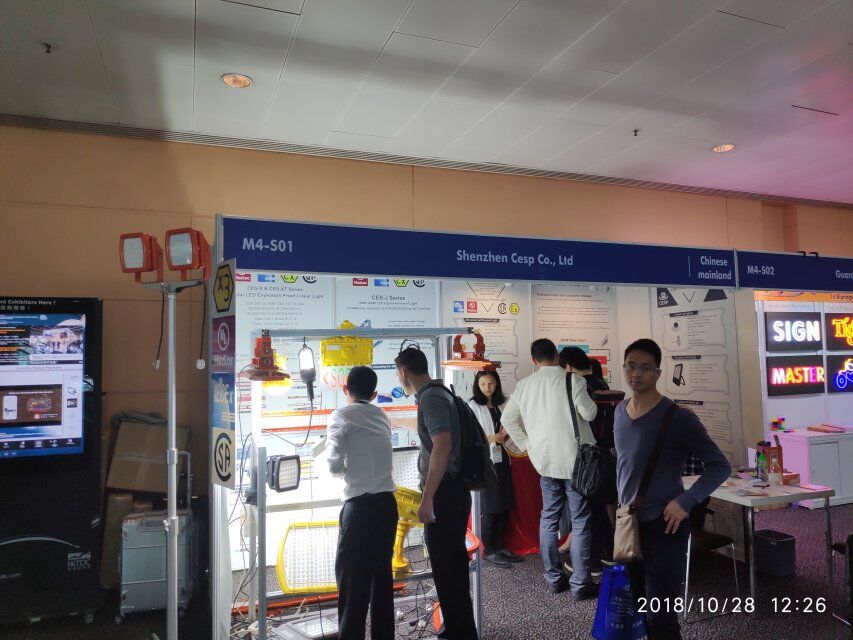
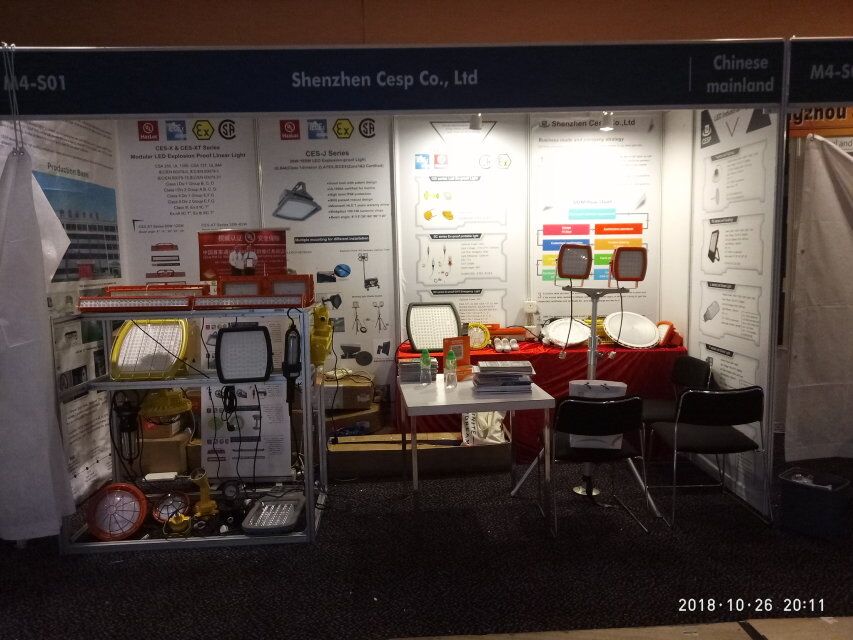
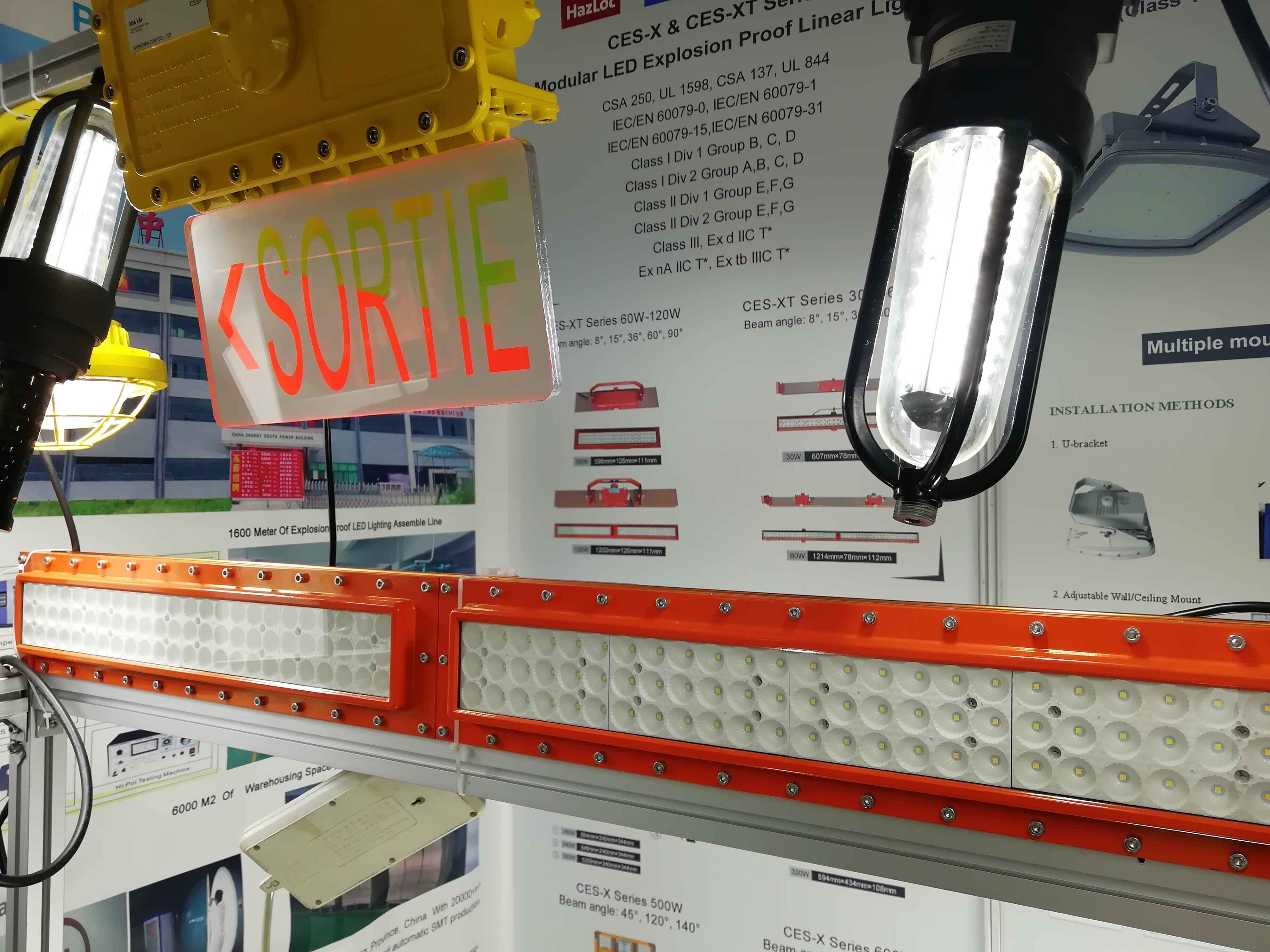
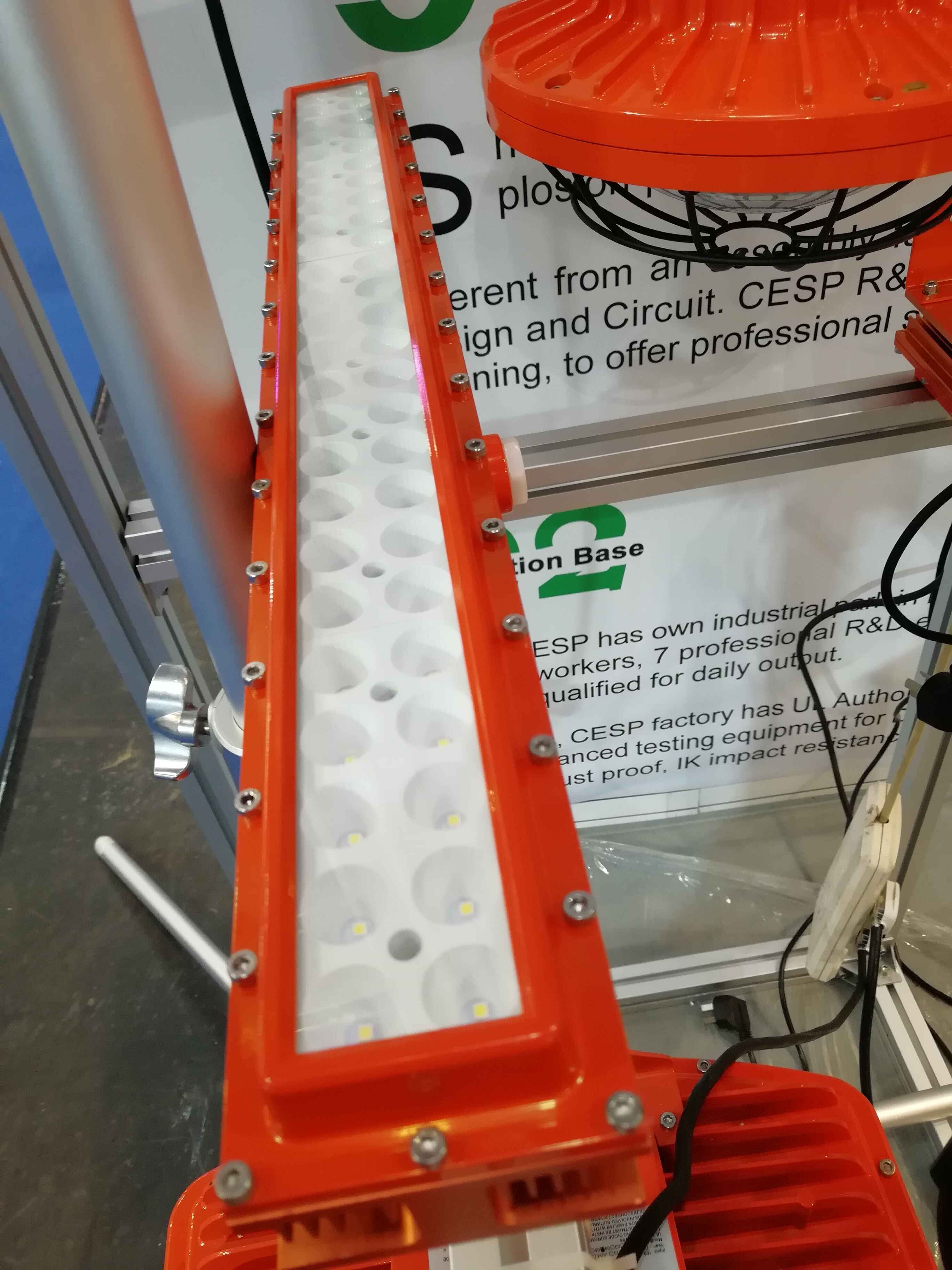
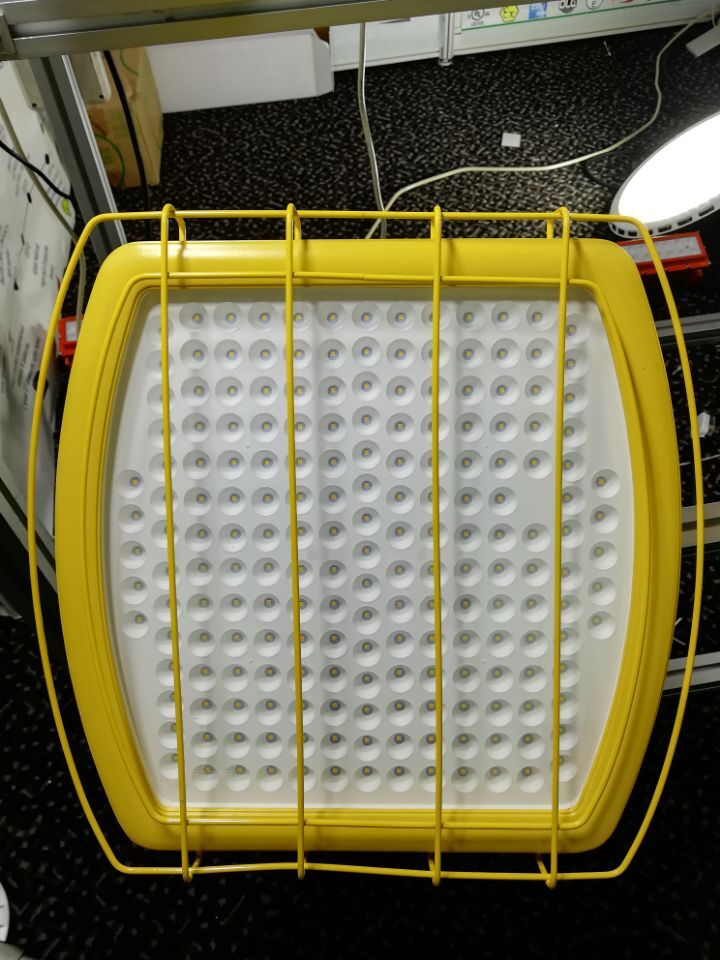
CESP in Hong Kong International Lighting Fair Autumn Edition 2018

Published in
Company News
Tagged under
Thursday, 12 April 2018 08:47
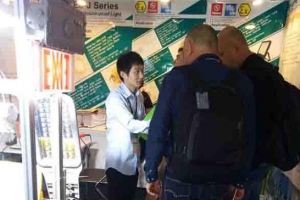
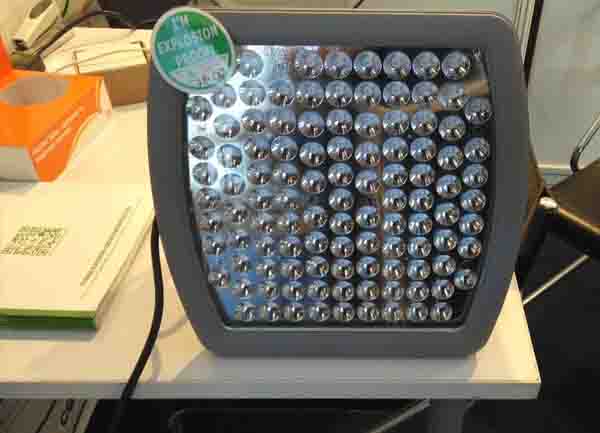
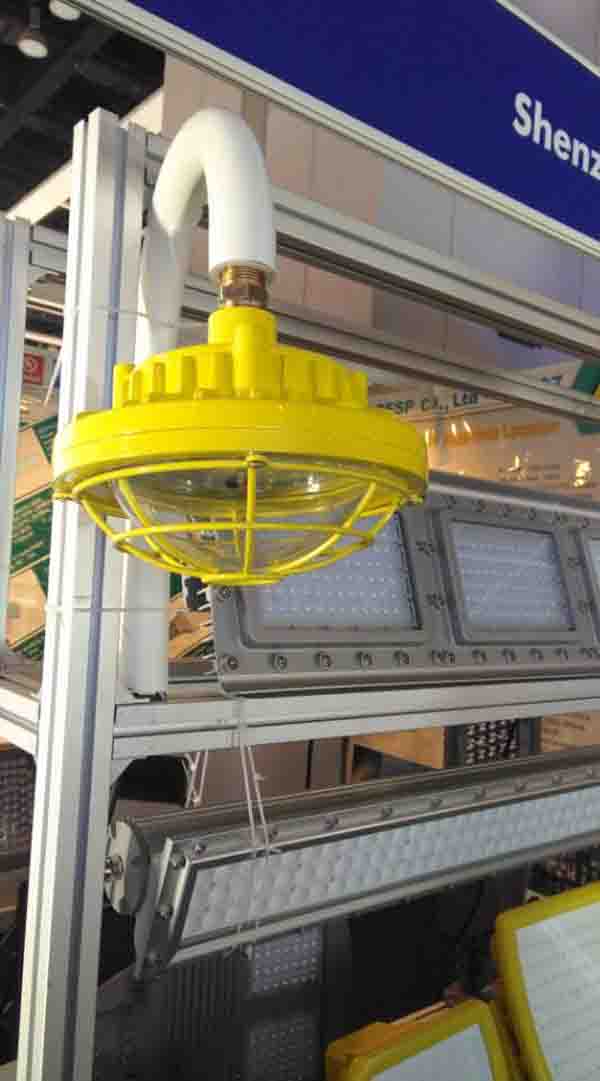
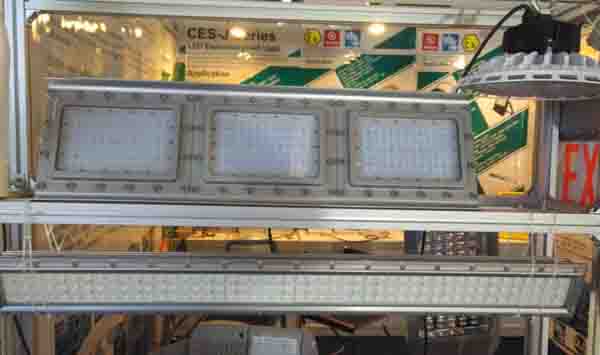
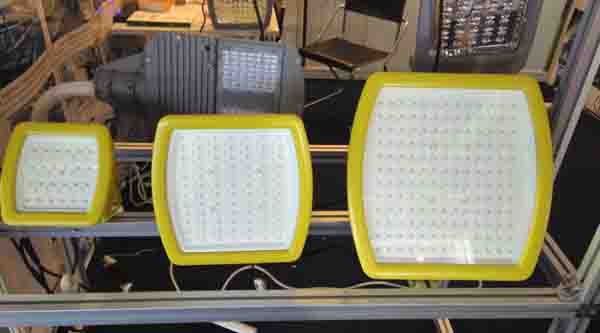
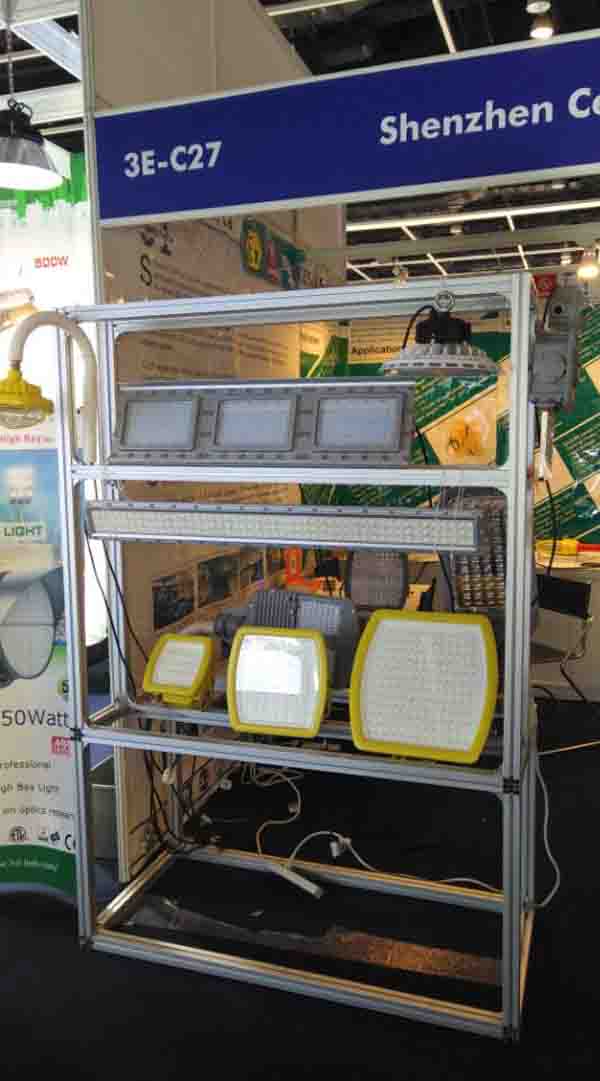
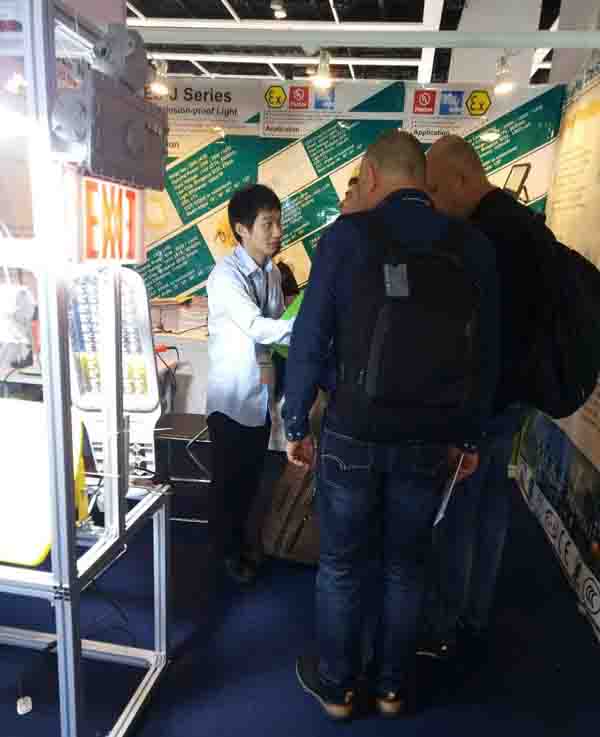
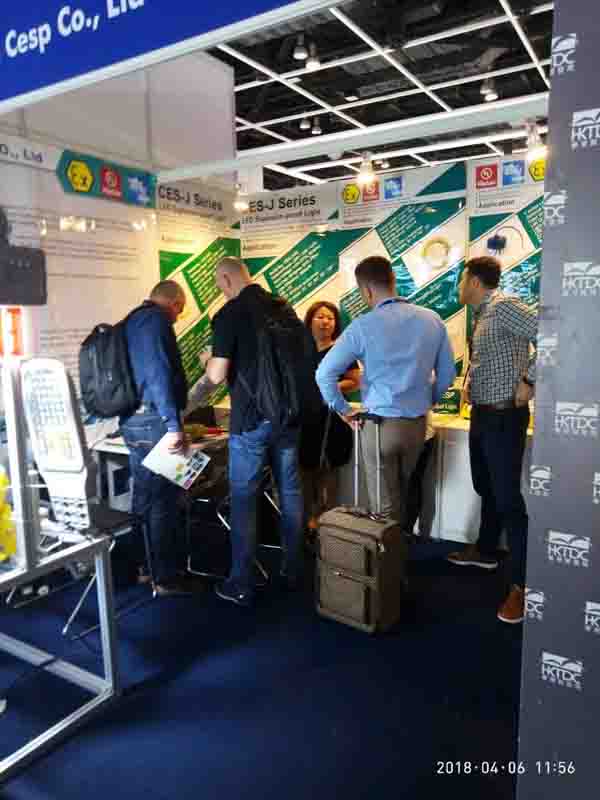
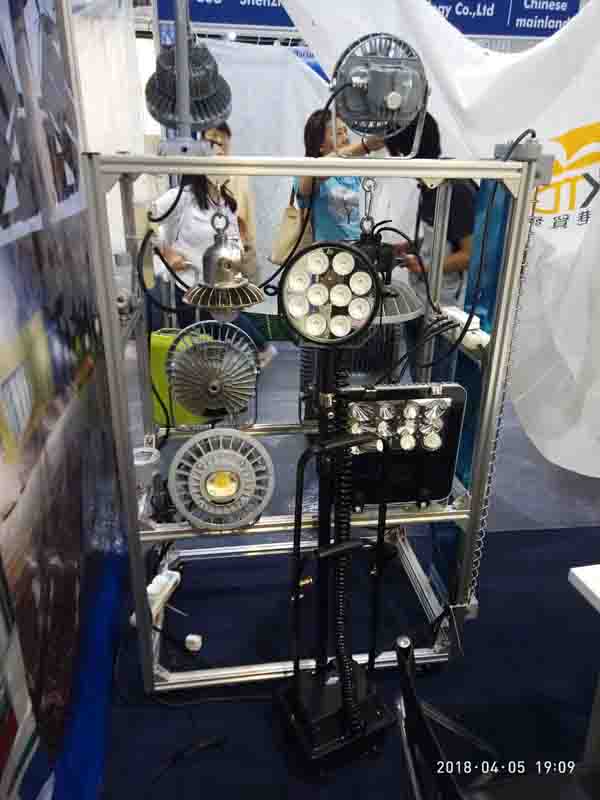
CESP in Hong Kong International Lighting Fair Spring Edition 2018

Published in
Company News
Tagged under
Thursday, 05 April 2018 08:43
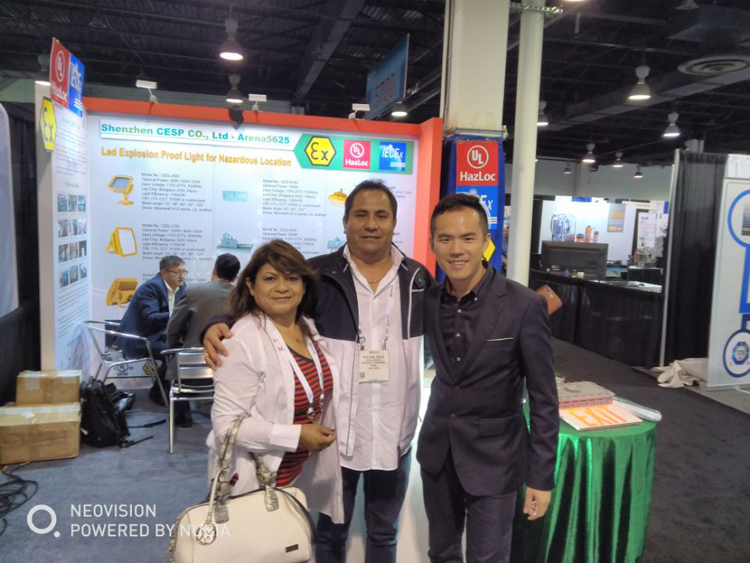
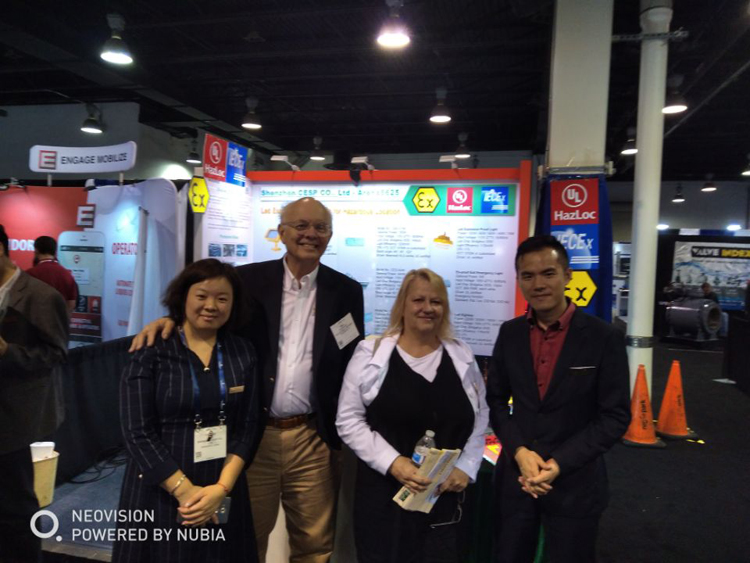
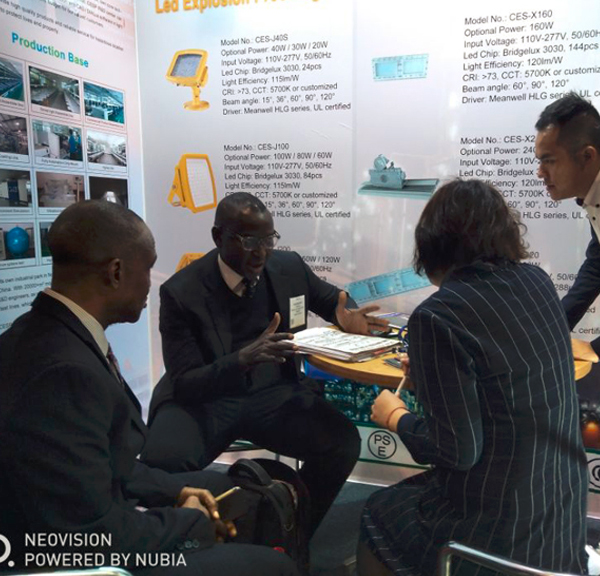
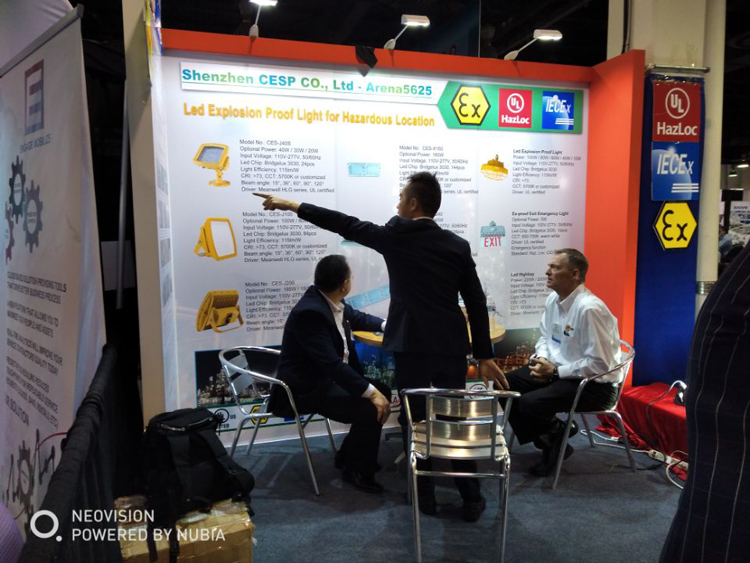
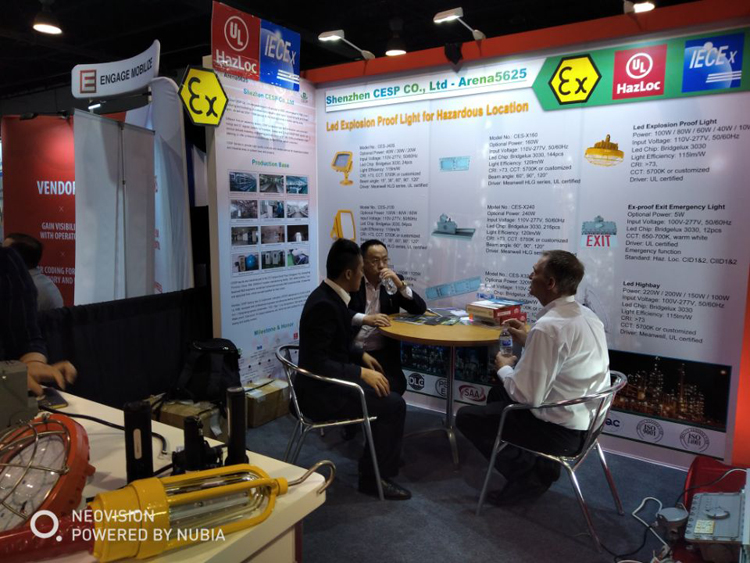
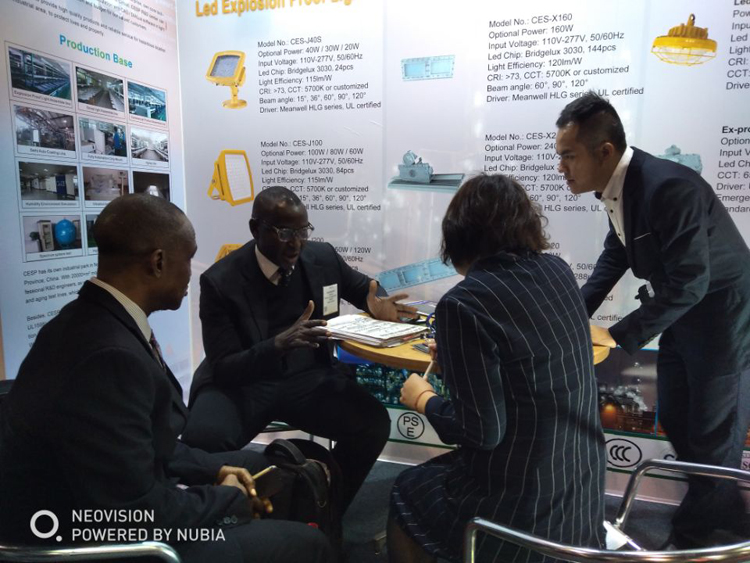
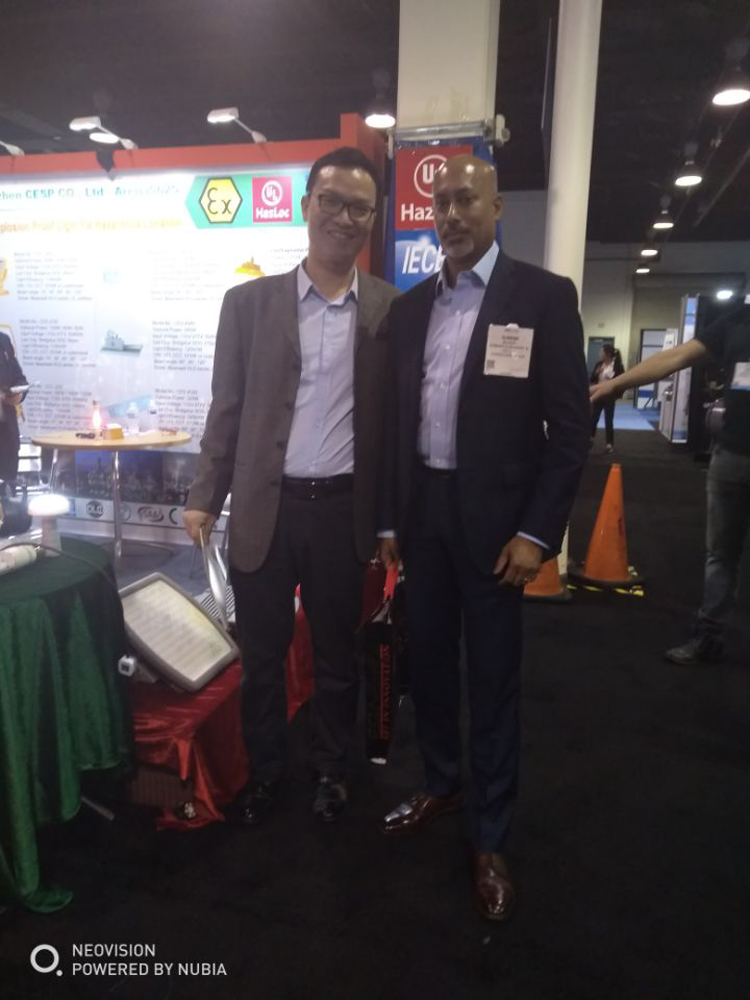
CESP Explosion-proof LED Lighting Fixtures in OTC (Houston, USA) Fair 2018


Published in
Company News
Tagged under